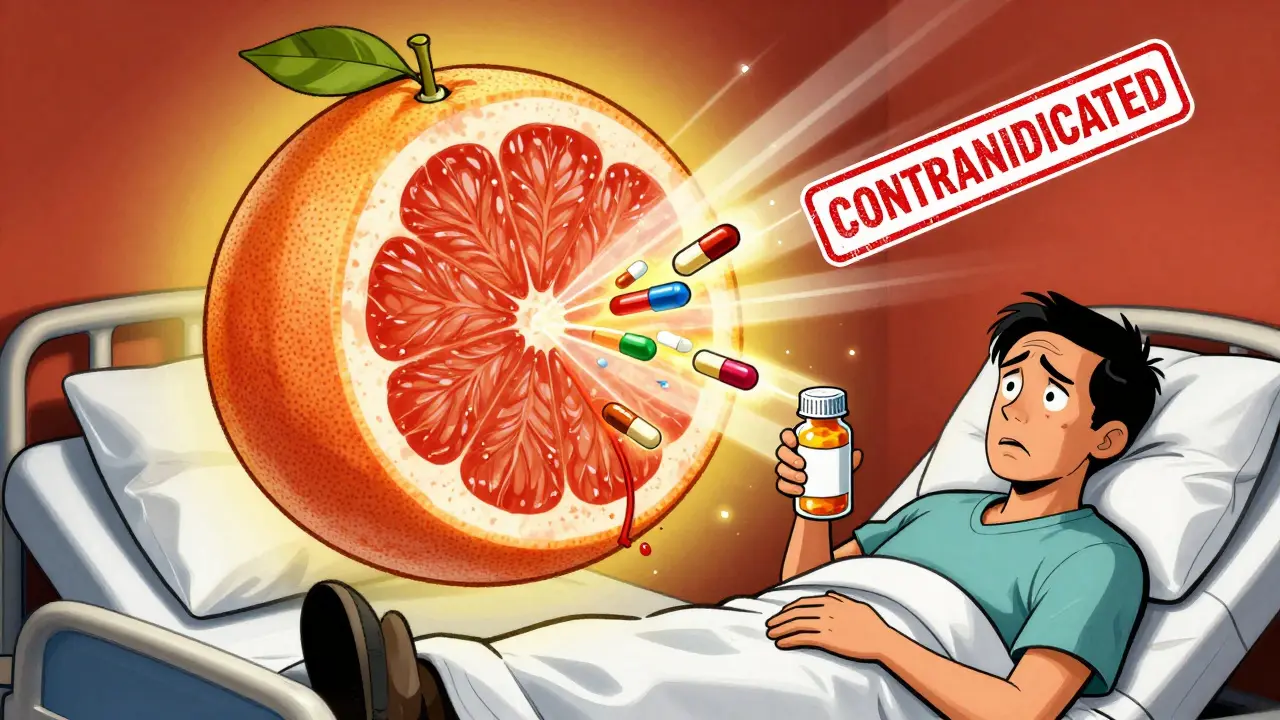
One glass of grapefruit juice might seem like a healthy start to your day-rich in vitamin C, low in calories, and packed with flavor. But if you’re taking an immunosuppressant after a transplant, that glass could be risking your life. This isn’t a myth. It’s not a warning you can ignore. It’s a grapefruit interaction that has sent people to the hospital, raised drug levels to toxic ranges, and even caused kidney failure.
Why Grapefruit Is Dangerous with Immunosuppressants
Grapefruit doesn’t just mix poorly with some medications-it rewires how your body handles them. The problem isn’t sugar or acidity. It’s chemicals called furanocoumarins, found naturally in grapefruit, pomelo, and Seville oranges. These compounds shut down an enzyme in your gut called CYP3A4. That enzyme is responsible for breaking down about half of all oral medications before they enter your bloodstream. When CYP3A4 is blocked, your body can’t process drugs like cyclosporine, tacrolimus, or sirolimus the way it should. Instead of 30% of the drug reaching your blood, suddenly it’s 80%, 100%, even 300%. For immunosuppressants, which already have a razor-thin safety margin, that’s catastrophic. Think of it like this: your transplant team spends weeks fine-tuning your dose so your body doesn’t reject the new organ-but doesn’t also shut down your immune system completely. A single grapefruit can throw that balance off. Within 24 hours, your blood levels can spike into the danger zone.Which Immunosuppressants Are Affected?
Not all immunosuppressants react the same way. But the ones that do are the most commonly prescribed:- Cyclosporine (Sandimmune, Neoral): Grapefruit can increase blood levels by 50-100%. Toxic levels start above 500 ng/mL; normal range is 100-400 ng/mL.
- Tacrolimus (Prograf, Envarsus XR): Levels can jump 30-50%, sometimes doubling. Normal range: 5-15 ng/mL. Toxic: over 20 ng/mL.
- Sirolimus (Rapamune): One study showed levels rising by 200-300%. Normal: 4-12 ng/mL. Toxic: above 20 ng/mL.
- Everolimus (Zortress): Added to the high-risk list in 2023. Same mechanism, same danger.
How Long Does the Effect Last?
Here’s where most people get it wrong. You don’t just need to avoid grapefruit on the day you take your pill. The enzyme damage is irreversible. Your body has to grow new CYP3A4 enzymes to replace the ones grapefruit destroyed. That takes time. Studies show that after drinking one 8-ounce glass of grapefruit juice:- At 24 hours: 47% of enzyme activity still blocked
- At 48 hours: 35% still blocked
- At 72 hours: 24% still blocked
Real Consequences: What Happens When People Ignore This Warning
This isn’t theoretical. People are getting sick-and sometimes dying-because they didn’t realize how serious this is. One kidney transplant patient on Reddit shared that after drinking a glass of grapefruit juice while on tacrolimus, his blood levels jumped from 8.2 ng/mL to 24.7 ng/mL in just 36 hours. He ended up in the hospital with acute kidney injury. His doctor told him, “This is why we tell you never to have it.” Another patient on an American Transplant Foundation forum reported tremors, nausea, and dangerously high potassium levels after eating half a grapefruit. His tacrolimus levels doubled. He needed emergency dialysis. Transplant pharmacists at Mayo Clinic reviewed cases from 2021-2022 and found that 15-20% of unexpected immunosuppressant toxicity cases were linked to undisclosed grapefruit use. Most patients didn’t think it was a big deal. “I only had a little,” they said. “I didn’t drink the juice, just ate the fruit.” But here’s the truth: even 200 milliliters-less than one cup-of grapefruit juice is enough to trigger a dangerous reaction. And eating the fruit? Just as risky. The furanocoumarins are in the pulp, the peel, the juice. All of it.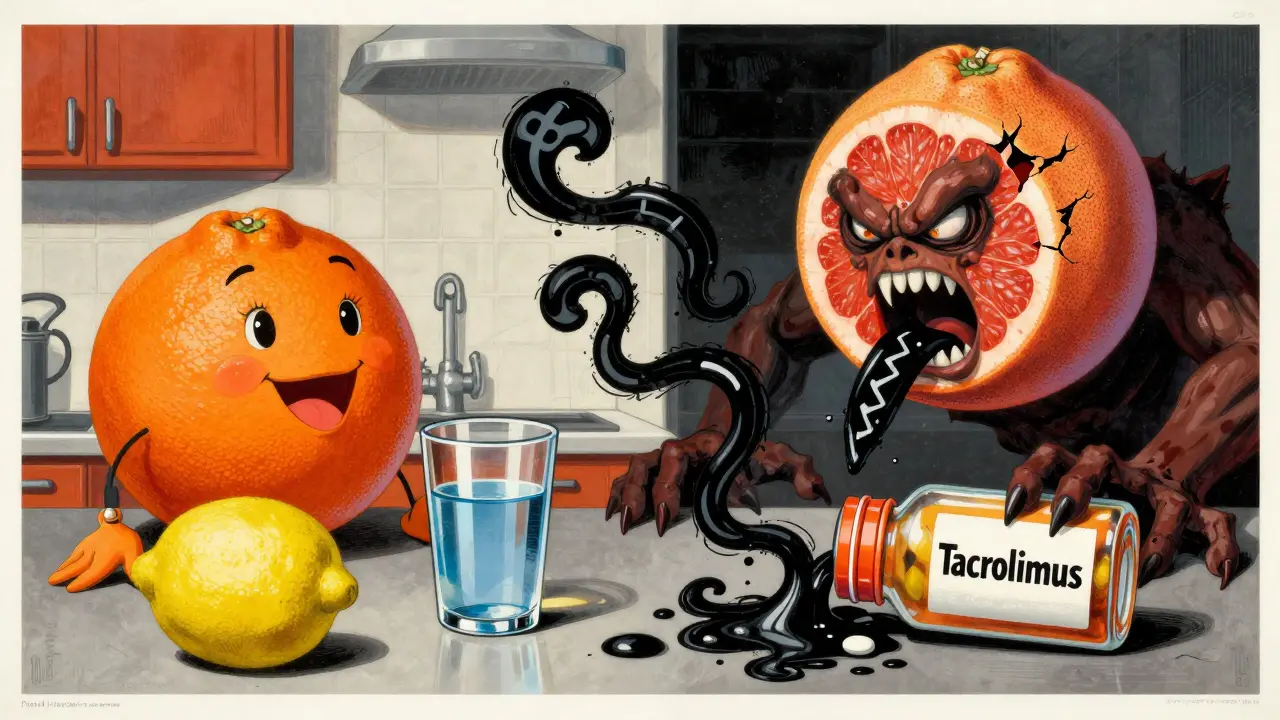
What About Other Citrus Fruits?
You might think, “Well, I’ll just switch to oranges.” That’s fine-sweet oranges, tangerines, and lemons are generally safe. They don’t contain the same furanocoumarins. But Seville oranges? Those are a problem. They’re used in marmalade, cocktails, and some baked goods. They’re genetically closer to grapefruit and contain the same dangerous compounds. If you’re not sure, check the label. Pomelo? Also dangerous. It’s a close relative of grapefruit. Even if it looks bigger and less tart, it carries the same risk. And don’t be fooled by “grapefruit-flavored” products. Some supplements, teas, or energy drinks contain concentrated grapefruit extract. Those can be even more dangerous than the juice itself.What Should You Do?
If you’re on an immunosuppressant, here’s what you need to do:- Avoid all grapefruit, pomelo, and Seville oranges-in any form. Juice, fruit, zest, extract, or supplements.
- Check your medication guide. Every prescription for cyclosporine, tacrolimus, or sirolimus now has a bolded FDA warning: “CONCOMITANT USE WITH GRAPEFRUIT IS CONTRAINDICATED.”
- Ask your pharmacist. They can scan your meds and tell you if grapefruit is a risk. Don’t assume your doctor told you everything.
- Wait 72 hours after eating grapefruit before taking your next dose. If you accidentally eat it, call your transplant team immediately.
- Use a barcode scanner app. Johns Hopkins launched one in January 2023 that scans your pill bottle and alerts you to grapefruit interactions in real time.
Why This Keeps Happening
You’d think after 34 years of warnings, people would get it. But a 2023 survey by the British Liver Trust found that 68% of transplant patients still don’t understand how serious this interaction is. Many think it’s just a “maybe” warning. Others believe they can have it “once in a while.” And here’s the sad part: older patients are at higher risk. About 40% of kidney transplant recipients are over 65. Many started eating grapefruit for heart health or to lower cholesterol. They don’t realize their transplant meds have changed the rules. The economic cost is also rising. Each hospitalization from grapefruit-induced toxicity costs around $18,500. In the U.S. alone, 300,000 transplant patients are on these drugs. Even 5-7% of cases add up to thousands of avoidable hospital stays every year.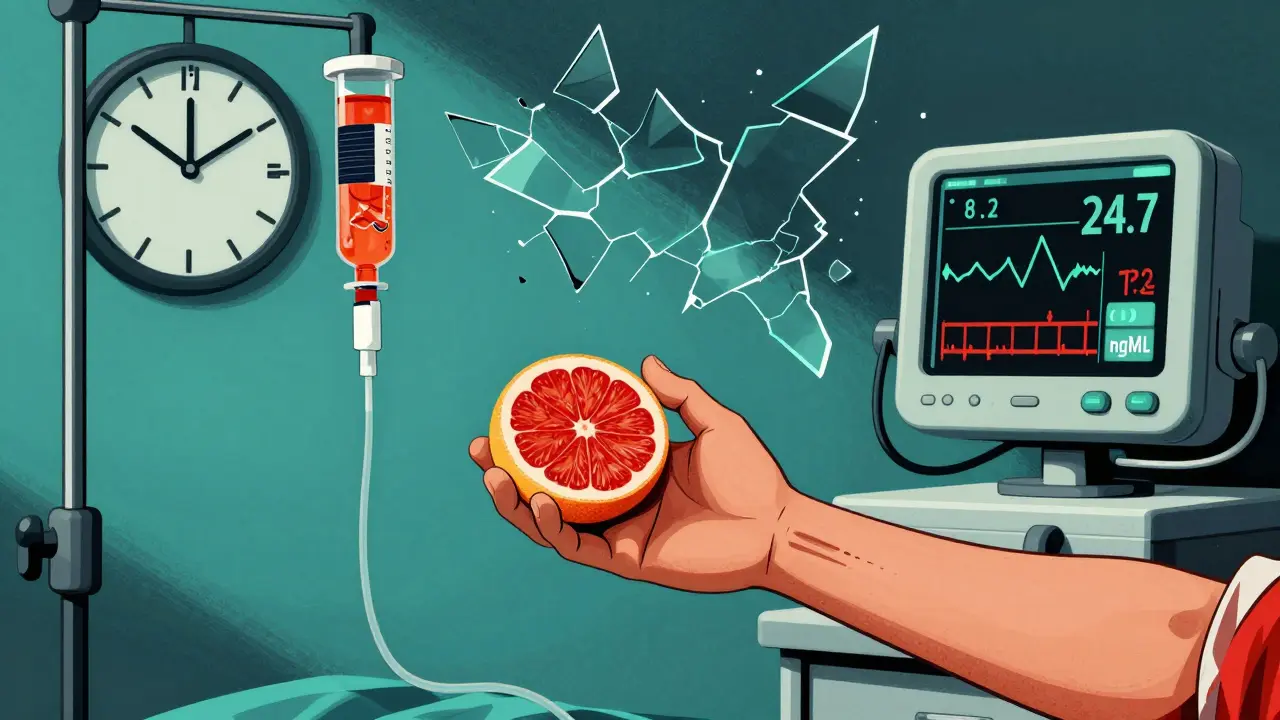
Is There Any Way Around It?
No. There’s no safe amount. No “just one piece.” No “I’ll take it at a different time.” Some researchers are exploring workarounds. A 2022 study found that taking activated charcoal within an hour of eating grapefruit reduced enzyme inhibition by 60%. But that’s still experimental. It’s not recommended. It’s not approved. And you can’t rely on it. The only proven, reliable, life-saving solution is complete avoidance.What to Eat Instead
You don’t have to give up citrus. Swap grapefruit for:- Oranges (navel, blood, Valencia)
- Tangerines or clementines
- Lemons and limes (in water, dressings, or as flavoring)
- Strawberries, blueberries, or kiwi for vitamin C
- Watermelon or cantaloupe for hydration and flavor
Final Warning
This isn’t about being perfect. It’s about being alive. Your transplant isn’t just a surgery-it’s a daily commitment. Your meds, your diet, your habits-they all matter. One grapefruit can undo months of recovery. One glass can land you in the ICU. One mistake can cost you your new organ. If you’re unsure, ask. If you’re tempted, remember: your body is working harder than ever to keep you alive. Don’t make it harder.Don’t risk it. Skip the grapefruit. Your future self will thank you.

14 Comments
Bryan Fracchia-28 January 2026
Man, I never realized how much one fruit could mess with your whole life after a transplant. I’ve been on tacrolimus for 5 years now, and I just assumed grapefruit was like caffeine-something you just had to ‘be careful with.’ Turns out, it’s more like handing your body a grenade and saying ‘pull the pin whenever you feel like it.’
Thanks for laying this out so clearly. I’m gonna print this out and tape it to my fridge next to my pill organizer.
Lance Long-29 January 2026
OH MY GOD. I just told my mom yesterday she could have some grapefruit with her breakfast-she’s on cyclosporine after her liver transplant. I thought it was just a ‘maybe’ warning. I’m literally running to the grocery store right now to throw out the whole damn crate. I’m so glad I saw this before it was too late.
You’re a lifesaver. Seriously. 🙏
Timothy Davis-31 January 2026
Let’s be real-this isn’t even a ‘warning.’ It’s a medical emergency waiting to happen. The fact that 68% of patients still don’t get it is a systemic failure. You don’t get to ‘maybe’ with pharmacokinetics. CYP3A4 inhibition isn’t a suggestion-it’s a biochemical bomb.
And don’t get me started on the ‘I only ate a little’ crowd. That’s like saying ‘I only drove 5 mph over the limit’ while blindfolded. The margin for error is zero. Zero. And yet, hospitals keep seeing these cases. It’s not ignorance-it’s negligence.
fiona vaz-31 January 2026
I’m a transplant pharmacist, and I see this every week. Patients will say, ‘But I’ve been eating grapefruit for 20 years!’ And I say, ‘Yes-and now your body is different. Your meds are different. The rules changed.’
It’s not about fear. It’s about facts. I keep a printed handout in every med bag I hand out. If you’re on one of these drugs, you need it. No exceptions. No ‘but I’m careful.’
Sue Latham- 1 February 2026
Ugh, I can’t believe people still don’t get this. I mean, it’s not like this is new news-it’s been in the FDA guidelines since 2001. If you’re too lazy to read your prescription label, don’t blame the system. You’re the one risking your life.
And honestly? If you think ‘eating the fruit’ is safer than juice, you clearly didn’t pay attention in high school bio. The furanocoumarins are in the white pith. The zest. The whole damn thing. It’s not a snack. It’s a drug interaction waiting to happen.
John Rose- 2 February 2026
This is one of those topics where science and personal freedom collide. I get it-you love grapefruit. It’s tart, refreshing, feels ‘healthy.’ But when you’re on immunosuppressants, your body isn’t just ‘you’ anymore. It’s a delicate ecosystem.
And honestly? If you’re willing to risk your new organ over a fruit, maybe you need to reevaluate what ‘health’ really means. It’s not about what you enjoy. It’s about what keeps you alive.
Lexi Karuzis- 3 February 2026
I knew it!!! I KNEW IT!!! 🚨🚨🚨 The pharmaceutical companies DO NOT WANT YOU TO KNOW THIS!!! They profit off of hospitalizations!!! They put grapefruit on the label because they’re scared of lawsuits, but they still sell it in the same aisle as your meds!!! And don’t get me started on the ‘barcode scanner app’-that’s just a distraction so you think you’re safe while they keep poisoning you!!! They’re hiding the truth about Seville oranges too!!! They’re all connected!!! THE GOVERNMENT IS IN ON IT!!!
Brittany Fiddes- 3 February 2026
Oh, for heaven’s sake, this is why Americans can’t handle basic science. In the UK, we’re taught this in secondary school. We don’t need ‘apps’ or ‘handouts’-we just read the bloody label. And yet here you are, treating a life-saving drug like a TikTok trend.
And don’t even get me started on ‘I only had a little.’ If you’re British, you’d know that ‘a little’ is still enough to kill you. We have a word for people who ignore this: dead.
Colin Pierce- 3 February 2026
I’ve been on sirolimus for 7 years. I used to eat grapefruit every morning-until my nurse pulled me aside one day and said, ‘You’re lucky you’re still here.’
Since then, I’ve swapped to blood oranges and a daily smoothie with kiwi and strawberries. I actually like it better now. And I’ve never had a single blood level spike since. It’s not a sacrifice-it’s a upgrade.
If you’re reading this and you’re on one of these meds? Do it. Your body will thank you.
Mark Alan- 4 February 2026
Bro. I just ate a grapefruit this morning. 😳
My transplant is next month. I’m gonna die. I’m gonna die and it’s all my fault. 🥲😭
Is it too late? Should I go to the ER? Should I drink charcoal? I’m panicking. HELP.
Amber Daugs- 4 February 2026
I don’t understand how anyone could be this careless. You’re lucky you even got a transplant. Some people wait years. And you’re throwing it away for a fruit? You’re selfish. You’re irresponsible. You’re a danger to yourself and everyone around you.
If you can’t follow basic medical advice, maybe you shouldn’t have been eligible for the transplant in the first place.
Ambrose Curtis- 5 February 2026
yo i just found out my cousin is on tacrolimus and she’s been eating grapefruit like its no big deal. i told her to stop but she said ‘it’s just one piece’ so i sent her this post. she said ‘damn, i thought it was just the juice.’ now she’s gonna get a fruit chart from the pharmacist. thank you for this. you saved her life.
also, i just googled ‘pomelo’ and holy crap it looks like a giant grapefruit. i’m never buying one again.
Linda O'neil- 5 February 2026
Hey-I’m a nurse who works in transplant. I’ve seen people come in with their organs failing because they thought ‘I’ll just have it on the weekend.’
It breaks my heart. But I also see people who get it. Who swap their fruit, who ask questions, who use the barcode app. They’re the ones who are still here five years later.
You’re not giving up flavor-you’re choosing life. And that’s worth more than any citrus.
Robert Cardoso- 7 February 2026
Let’s analyze this scientifically. The CYP3A4 enzyme inhibition is well-documented, yes. But the 72-hour window? That’s based on in vitro studies with concentrated juice. In vivo, individual metabolic variation, gut microbiome composition, and genetic polymorphisms in CYP3A5 can significantly alter the duration and magnitude of inhibition.
Therefore, the blanket recommendation of ‘avoid for 72 hours’ is not evidence-based for all patients. Some may metabolize it faster. Others slower. A one-size-fits-all protocol ignores pharmacogenomics. This is why personalized medicine is the future-not fear-mongering.
Also, activated charcoal has been shown in multiple RCTs to reduce bioavailability. Why isn’t this being promoted? Because it’s cheaper to scare people than to educate them.