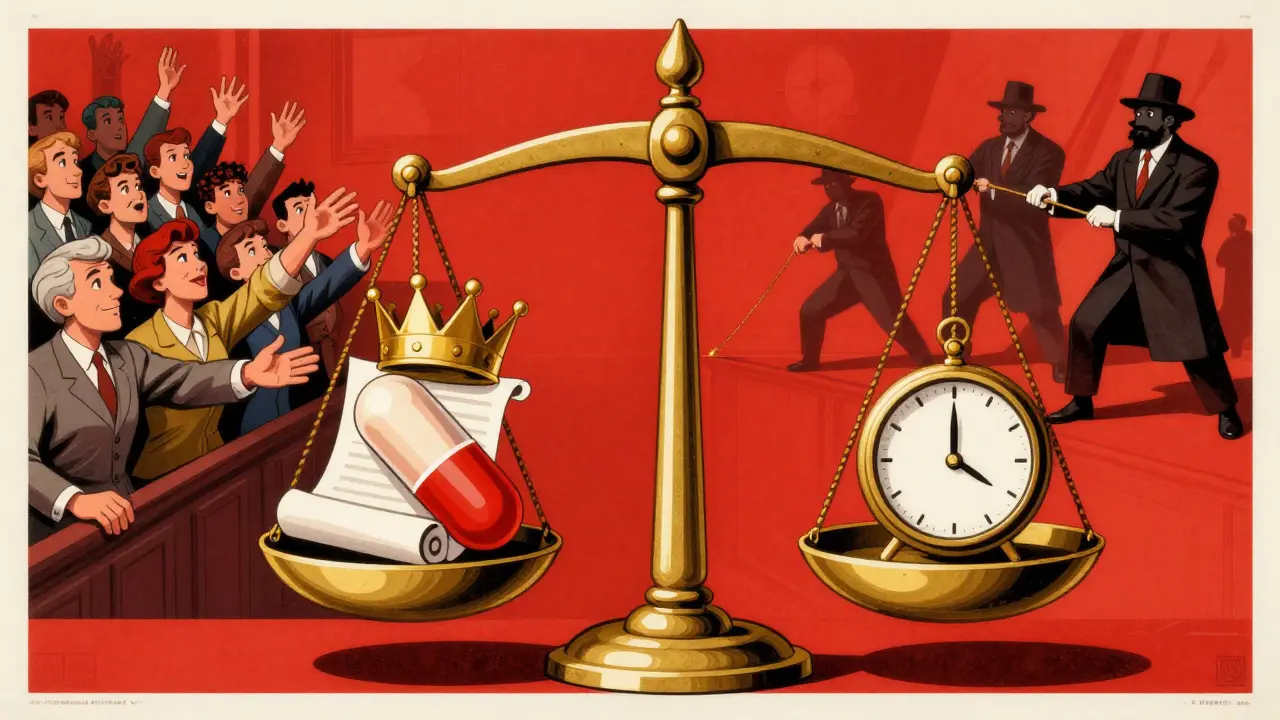
The U.S. generic drug market didn’t just happen. It was built by a law passed in 1984 that still shapes how you get your prescriptions today. That law is the Hatch-Waxman Act the Drug Price Competition and Patent Term Restoration Act of 1984, a landmark U.S. law that created the modern system for approving generic drugs while protecting brand-name drug patents. Before this law, getting a generic drug approved was nearly impossible. The FDA required full clinical trials - the same ones brand-name companies spent millions on. That meant generics were rare, expensive, and slow to enter the market. In 1983, fewer than 10 generic drugs were approved. By 2022, the FDA approved over 770. Today, 90% of prescriptions in the U.S. are filled with generics - and they cost just 15% of what the brand-name version charges.
Why the Hatch-Waxman Act Was Needed
In the early 1980s, two big problems were holding back generic drugs. First, the Supreme Court had ruled in Roche v. Bolar that testing a patented drug before the patent expired was illegal - even if the only goal was to get FDA approval. That meant generic companies couldn’t start preparing until the patent ran out. By then, they’d lost years of time. Second, brand-name drugmakers were losing valuable patent life. The FDA approval process could take five to seven years. That meant a drug with a 20-year patent might only have 13 years left to sell before generics showed up. No company would invest $1 billion in R&D if they’d only have 13 years to make a profit.
The Hatch-Waxman Act solved both problems at once. It didn’t take sides. It didn’t crush patents. It didn’t ban generics. Instead, it created a deal: innovators get more patent time, generics get a faster path to market.
The Two Big Tools: ANDA and Patent Restoration
The Act gave generic drugmakers one game-changing tool: the Abbreviated New Drug Application (ANDA) a streamlined FDA approval pathway that allows generic manufacturers to prove bioequivalence to a brand-name drug without repeating costly clinical trials. Instead of running new safety and efficacy studies, a generic company only needs to show their pill delivers the same amount of medicine into the bloodstream as the original. That cuts development costs by about 75% and slashes approval time from years to months.
For brand-name companies, the Act gave them something they’d been begging for: patent term restoration a mechanism that extends a drug’s patent to make up for time lost during FDA review, with an average extension of 2.6 years between 1984 and 2019. The law lets innovators apply for up to five extra years of exclusivity - but no more than 14 years total after the original patent grant. This wasn’t a giveaway. It was a trade. In exchange for letting generics move faster, innovators got to keep their profits longer.
The Paragraph IV Gamble
But here’s where things got complicated. The Act created a way for generics to challenge patents before they expire. This is called the Paragraph IV certification a legal mechanism under the Hatch-Waxman Act that allows a generic manufacturer to claim a brand-name drug’s patent is invalid or won’t be infringed, triggering a 30-month litigation delay. If a generic company files an ANDA and says, "This patent is invalid," the brand-name company has 45 days to sue. If they do, the FDA can’t approve the generic for 30 months - even if the patent has expired.
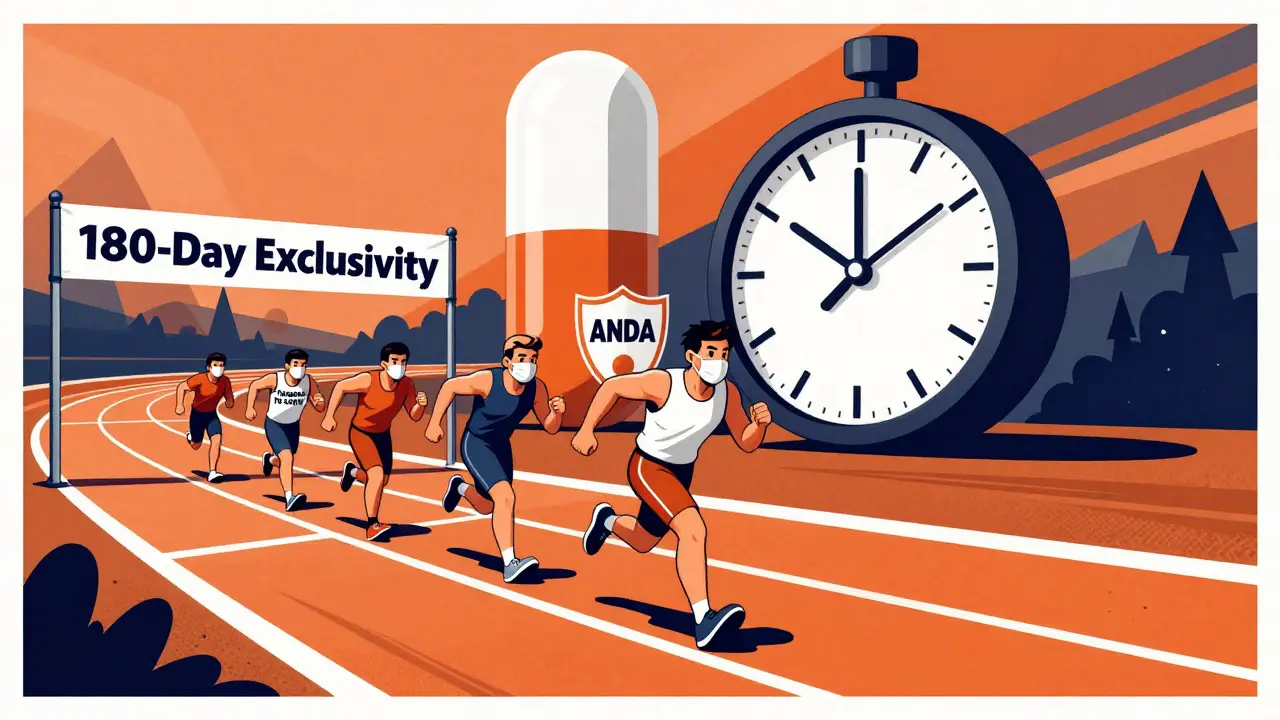
Why would a generic company do this? Because the first one to file gets a prize: 180 days of exclusivity a period during which no other generic can enter the market after the first filer’s Paragraph IV certification is accepted, creating a financial incentive for early challengers. During those six months, that single generic can charge higher prices - sometimes close to brand-name levels - while everyone else waits. This turned the ANDA process into a race. In the late 1990s, companies would camp outside FDA offices just to be first. The FDA changed the rules in 2003 to let multiple companies share the exclusivity if they filed on the same day. But the incentive is still there.
What’s Broken? Patent Thickets and Pay-for-Delay
The system worked well for years. But over time, both sides found ways to game it.
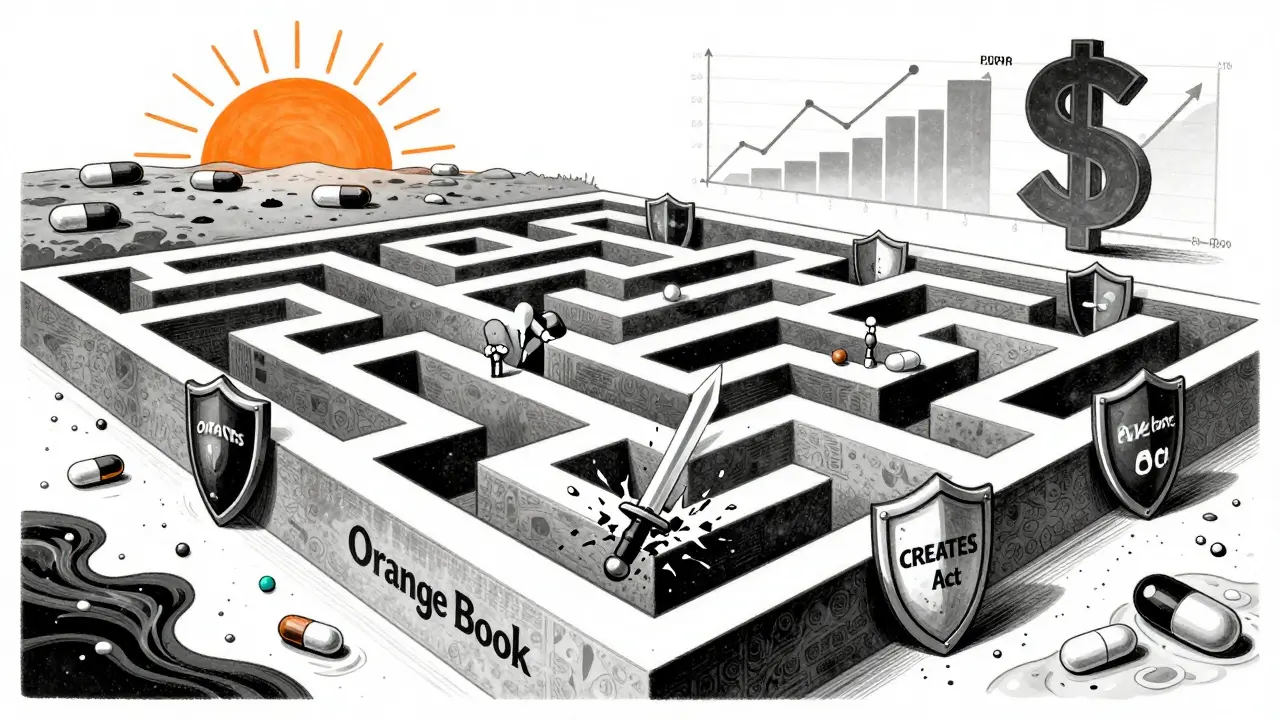
Brand-name companies started filing dozens of patents on minor changes - a new coating, a slightly different pill shape, a new use for an old drug. These are called secondary patents patents on minor modifications of a drug, such as dosage form or method of use, used strategically to extend market exclusivity beyond the original patent. In 1984, a typical drug had 3.5 patents listed in the FDA’s Orange Book. By 2022, it was 14. That’s a threefold increase. These patents create "thickets" - a maze of legal barriers that delay generics for years.
Then there’s pay-for-delay a settlement where a brand-name drugmaker pays a generic company to delay launching its competing product, effectively extending the brand’s monopoly. Between 2005 and 2012, 10% of all Paragraph IV challenges ended in these deals. A brand company would pay a generic firm hundreds of millions to stay off the market. The FTC called it "anticompetitive." In 2013, the Supreme Court ruled these deals could be illegal - but they didn’t stop. In 2022, the FDA reported 262 cases where drug monopolies were extended beyond patent expiration using these tactics.
And the delays aren’t small. One study found that patent thickets and litigation now delay generic entry by an average of 2.7 years. That’s longer than the original patent extension the Act was meant to provide.
The Real Cost - and the Real Savings
Despite the gaming, the Hatch-Waxman Act still saves billions. In 2022, generics saved the U.S. healthcare system $313 billion - that’s more than the entire GDP of Norway. Since 1991, the Congressional Budget Office estimates the Act saved $1.18 trillion. That’s because generics don’t just cost less. They change behavior. Once a generic hits the market, prices drop to 15% of the brand name within six months. Pharmacies switch. Doctors prescribe. Patients refill.
But the savings aren’t evenly distributed. The top 10 generic manufacturers now control 62% of the market - up from 38% in 2000. Why? Because navigating the Orange Book, filing ANDAs, and fighting patent lawsuits costs $15 million to $30 million per drug. Only big companies can afford that. Small players get squeezed out.
What’s Changing Now?
The system is under pressure. In 2022, Congress passed the CREATES Act a law that prevents brand-name drugmakers from blocking generic companies from obtaining samples needed for bioequivalence testing. Before this, some brand companies refused to sell samples - a tactic that blocked generics from even starting testing.
In 2023, the House passed the Preserve Access to Affordable Generics and Biosimilars Act legislation that would ban "reverse payment" settlements between brand-name and generic drug manufacturers. If it becomes law, it would outlaw pay-for-delay deals.
The FDA is also trying to clean up the Orange Book. In 2022, it proposed stricter rules on which patents can be listed - targeting those that are vague, outdated, or cover trivial changes. By 2025, the agency aims to cut ANDA review times from 10 months to 8 months under its latest user fee agreement.
But there’s a risk. If the rules get too strict, innovators might stop developing new drugs. Japan tried a similar reform in 2018 - and saw a 34% drop in new small-molecule approvals. The U.S. can’t afford that. The goal isn’t to kill Hatch-Waxman. It’s to fix the loopholes.
Is the Act Still Working?
Yes - but not perfectly. The core idea still holds: let generics in faster, give innovators time to recoup their investment. The data proves it. Without Hatch-Waxman, we wouldn’t have 90% generic prescriptions. We wouldn’t have the $313 billion in annual savings. We wouldn’t have the 15,678 generic drugs approved since 1984.
But the system is no longer a balance. It’s a battleground. Brand companies use patents like shields. Generic companies use Paragraph IV like a sword. And patients? They’re stuck in the middle - paying more than they should because of legal delays, not science.
The next five years will decide if Hatch-Waxman evolves - or collapses under its own weight. The law was built for a different time. The question now is whether we can update it without breaking what still works.


11 Comments
Mary Beth Brook- 9 March 2026
The Hatch-Waxman Act was a masterstroke of regulatory engineering. ANDA pathways? Patent term restoration? Brilliant trade. No ideological extremism. Just cold, calculated policy that delivered outcomes. 90% generic penetration isn't luck-it's design. And yet, we're letting it rot with pay-for-delay and patent thickets. This isn't capitalism. It's rent-seeking dressed in white coats.
Fix the Orange Book. Kill reverse payments. End secondary patent gaming. Or stop pretending we care about affordable meds.
Neeti Rustagi-10 March 2026
It is truly remarkable how the structural incentives embedded within the Hatch-Waxman framework have, over time, evolved into mechanisms that subtly undermine the very objectives they were intended to serve. The original equilibrium-patent protection in exchange for accelerated generic entry-has been destabilized by strategic litigation and regulatory arbitrage.
One cannot overlook the fact that the proliferation of secondary patents has transformed what was once a transparent pathway into a labyrinthine obstacle course. The FDA’s recent proposals to refine Orange Book listings are, therefore, not merely administrative adjustments-they are necessary corrections to preserve public trust in the system.
Dan Mayer-11 March 2026
ugh so the act was good but now its all broke because big pharma is cheating like always and the fda is too slow and the gernics cant even get samples to test?? like wtf?? and then they pay each other to not sell?? this is like a cartoon villain plot but its real and we are paying for it. also i think they mean ANDA not ANDA?? or is that right?? idk im tired
Janelle Pearl-12 March 2026
I’ve been on insulin for 12 years. My first generic was $25. Now? $450. Not because of science. Because of patents no one understands.
I don’t care about the law’s intent. I care that my kid can’t afford to breathe.
I’ve watched this system turn a life-saving drug into a luxury item. And I’m tired of being told it’s "balanced."
Ray Foret Jr.-13 March 2026
This is actually one of those rare policy wins that *works* 😊 The fact that 90% of prescriptions are generic? That’s HUGE. And yeah, the system’s got glitches-pay-for-delay is trash, and patent thickets are a scam-but the core idea? Still golden.
Let’s fix the loopholes, not scrap the whole thing. We’re saving $313B a year. That’s not a bug. That’s a feature. 🙌
Samantha Fierro-14 March 2026
The structural integrity of the Hatch-Waxman Act remains intact, despite the erosion of its intended equilibrium. The emergence of strategic patenting and reverse payment settlements represents not a failure of design, but a failure of enforcement.
It is imperative that regulatory bodies exercise their statutory authority to limit the listing of non-essential patents and to prohibit monetary inducements for market delay. The public interest must supersede corporate expediency.
Robert Bliss-15 March 2026
I never thought about how generics even got approved before this. Like, wow. The ANDA thing is genius. Why make 1000 people do trials again? Just prove it’s the same. Duh.
And yeah, pay-for-delay is gross. But honestly? I’m just glad I can get my blood pressure med for $4. Thank you, 1984 Congress. 🙏
Peter Kovac-15 March 2026
Let us not romanticize the Hatch-Waxman Act. It was a political compromise, not a public health triumph. The 90% generic penetration statistic is misleading-it masks the concentration of market power among six corporations.
The $313 billion savings figure ignores externalized costs: delayed innovation, suppressed R&D in small firms, and the psychological toll of pharmaceutical uncertainty. The act did not democratize access-it industrialized it.
And the Paragraph IV litigation system? A legal arms race subsidized by taxpayer-funded FDA reviews. The winners are not patients. They are litigation departments.
Judith Manzano-15 March 2026
I’m curious-how many of those 770 generic approvals in 2022 were actually for drugs that had their patents challenged via Paragraph IV? And what percentage of those challenges succeeded? The data’s out there, but it’s buried. Someone should map it.
rafeq khlo-16 March 2026
The entire system is a facade. Patent term extension was never meant to be 2.6 years on average. It was a temporary buffer. Now it’s a permanent shield. And the FDA’s approval delays? They are not bureaucratic inefficiency. They are collusion by design. The system is not broken. It was built this way. To enrich. To exclude. To control.
Morgan Dodgen-16 March 2026
They told us Hatch-Waxman was about competition. But look at the Orange Book. 14 patents per drug? That’s not innovation. That’s a legal chokehold. And the FDA? They’re complicit. The CREATES Act? Too little. Too late. The real story? Big Pharma owns the FDA. They wrote the rules. They fund the reviewers. They control the samples. And now they’re laughing while we pay $500 for a 1970s drug.
Ever heard of the ‘revolving door’? Yeah. It’s not a metaphor. It’s a conveyor belt. From pharma lobby to FDA commissioner in 18 months. Coincidence? 😏