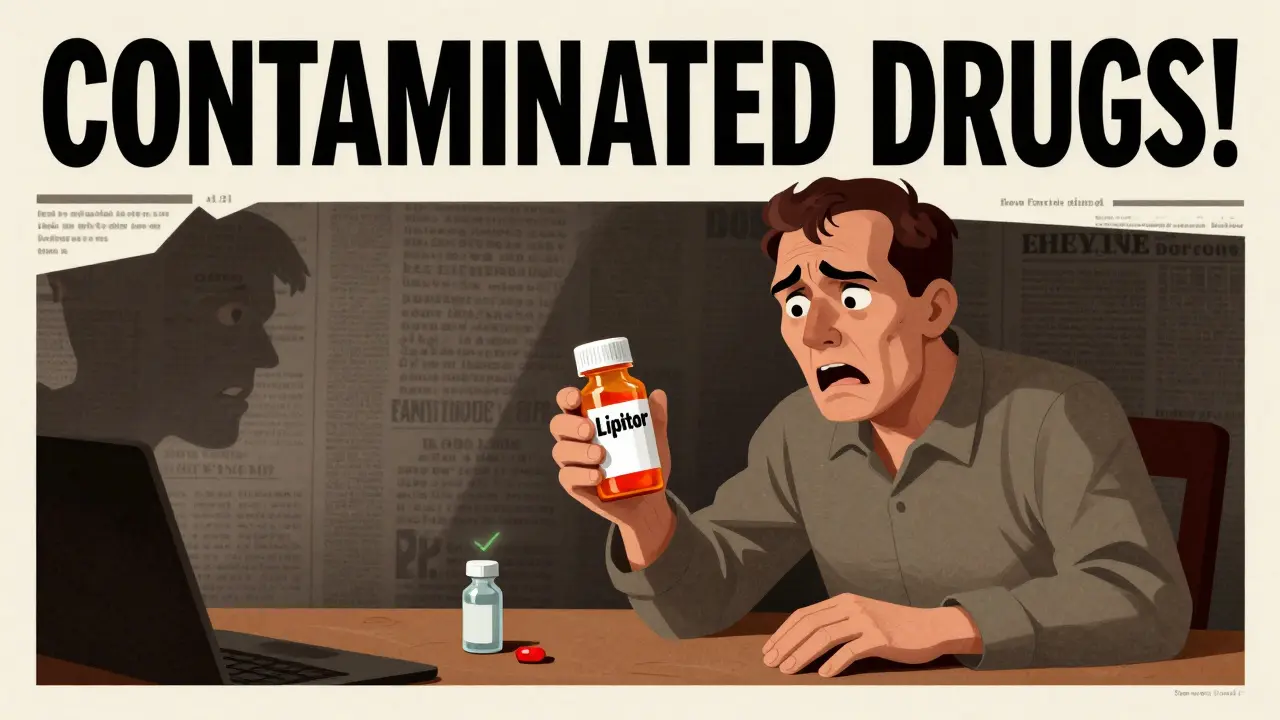
Every year, generic drugs make up 84% of all prescriptions filled in the U.S. Yet, if you ask most people whether they’d trust a generic version of their medication, many will hesitate. Why? Not because the science says otherwise - but because of what they read in the news.
Headlines like "Contaminated Generic Drugs Reveal an Urgent Public Health Crisis" or "How Some Generic Drugs Could Do More Harm Than Good" don’t just report facts. They shape fear. And fear changes behavior. Patients who once happily took their generic blood pressure pill start asking for the brand name, even if it costs three times as much. They don’t know the difference - and the media rarely helps them learn it.
Generic Drugs Are Just as Safe - But the News Doesn’t Say That
The FDA requires every generic drug to have the same active ingredient, strength, dosage form, and route of administration as the brand-name version. They must also prove they work the same way in the body. That’s not a suggestion. It’s the law. Yet, when a news story reports on a drug recall or contamination, it rarely clarifies whether the issue affected the brand, the generic, or both. More often than not, it just says "drug" - and people assume the worst.
Studies show that media reports rarely mention the manufacturer’s name or whether the product is generic. In fact, a 2014 JAMA Network analysis found that only 2% of newspapers had written policies requiring reporters to use generic names. Most still say "Lipitor" instead of "atorvastatin," even when writing about the generic version. That’s not just sloppy journalism - it’s misleading. When patients hear "Lipitor" in a scary headline, they think their generic version is somehow different. It’s not. But the language makes them believe it is.
Why People Can’t Tell the Difference - Even When They Hold the Bottle
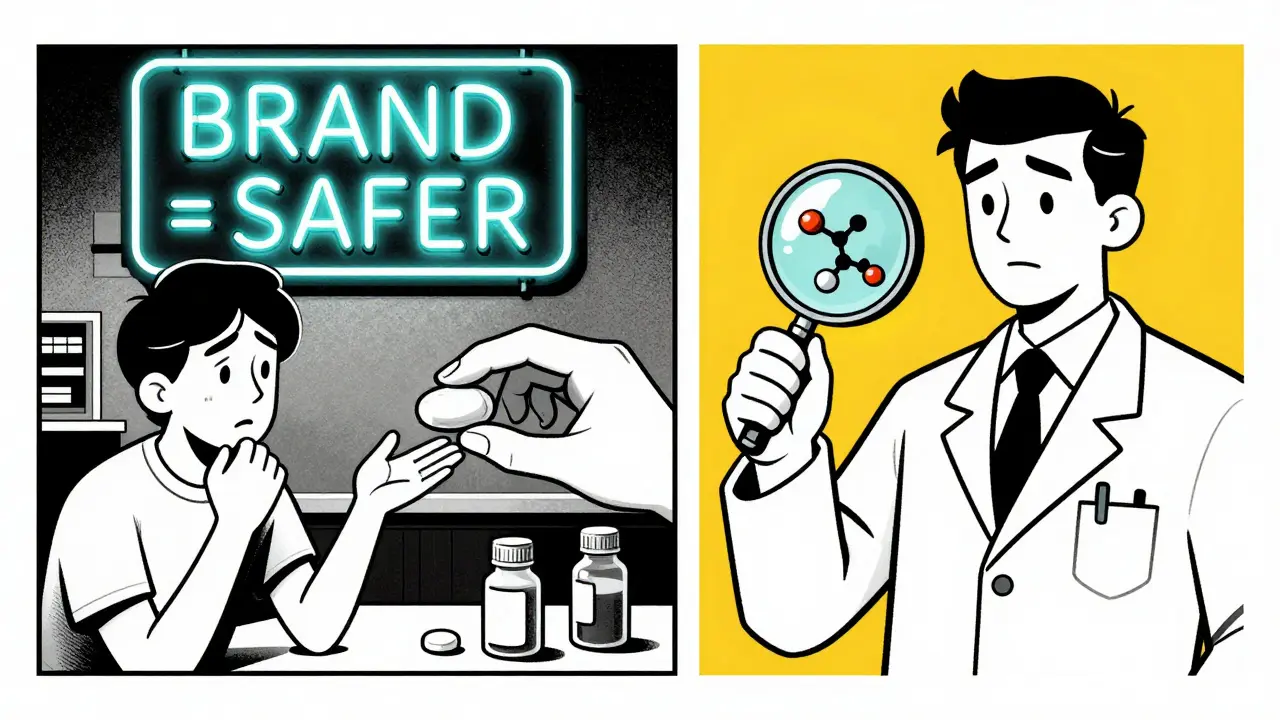
Here’s something startling: only 17% of people could correctly identify a generic medicine package in a 2023 study. About 40% couldn’t tell the difference between a brand and a generic pill just by looking at the packaging. That’s not because they’re careless. It’s because the system doesn’t help them learn.
Brand-name drugs have logos, colors, shapes, and catchy names. Generics? Often, they’re just white pills with a code stamped on them. The FDA allows these differences in inactive ingredients - things like fillers or coatings - but those changes don’t affect how the drug works. Still, when a patient switches from a blue capsule to a white tablet, they assume something’s wrong. They don’t realize the active ingredient is identical. And without clear education, they assume the worst.
Bad News Hits Harder - Especially After a Health Diagnosis
It’s not just headlines. It’s timing. A 2023 study from the University of Texas at Dallas found that patients are most likely to reject generics within the first 90 days after receiving bad health news - like a diabetes diagnosis or a cancer scare. In those moments, people aren’t thinking about cost. They’re thinking about control. They want the "best" option, even if it’s more expensive. And the media feeds that instinct.
When a patient reads that a generic drug was recalled overseas, or that a manufacturer had quality issues, they don’t think, "That was one batch, in one country." They think, "This whole class of drugs is risky." And they switch back to the brand - even if their insurance won’t cover it. That’s not logic. It’s emotion. And the media doesn’t help them calm down. It amplifies the fear.
Doctors and Pharmacists Are the Missing Link
Here’s the good news: when a doctor or pharmacist explains the facts, patients listen. A 2015 systematic review found that trust in a healthcare provider often overrides personal doubts about generics. That’s powerful. But too few providers take the time.
Pharmacists, in particular, are in the perfect position to help. They’re the ones handing out the pills. They see the confusion. They know the science. But they’re often rushed. In one 2023 study published in US Pharmacist, patients who received even a brief explanation from their pharmacist - "This is the same medicine, just cheaper" - were significantly more likely to stick with the generic.
And it’s not just patients. Even some doctors are skeptical. A 2010 study found that some physicians still believe generics are inferior, despite decades of evidence to the contrary. If the person prescribing the drug doesn’t believe in it, why would the patient?
The Real Cost of Misinformation
Every time someone chooses a brand-name drug over a generic because they’re scared, the system pays. The U.S. spends over $100 billion a year on brand-name drugs that could be replaced with generics. That’s money that could go to better care, better access, better outcomes.
And here’s something most media stories ignore: competition drives prices down. When three or more generic versions of a drug hit the market, prices drop by about 20%. That’s not a rumor. It’s from a 2023 HHS report. But you won’t see that in a headline about a single drug recall. Instead, you see fear. And fear sells.
What Needs to Change - And Who Can Fix It
Journalists aren’t the enemy. Many just don’t know the science. A 2014 JAMA study recommended that news outlets adopt clear policies: always use generic names, always disclose funding sources, always clarify when a problem applies to one batch or one manufacturer. That’s a start. But it’s not enough.
Health systems need to step up. The FDA has launched outreach programs to improve generic drug literacy - but they’re not reaching most people. Patient advocacy groups, pharmacies, and clinics need to run simple, clear campaigns: "Your generic pill works the same. Here’s why." Posters in waiting rooms. Handouts at the pharmacy counter. Short videos on hospital websites.
And patients? They need to ask questions. If your doctor prescribes a generic, ask: "Is this the same as the brand?" If you see a scary headline, ask: "Was this about the generic version? Did it affect U.S. products?" Knowledge is the antidote to fear.
The science is clear. The data is solid. Generic drugs are safe, effective, and save billions. But belief doesn’t come from studies. It comes from trust. And right now, the media is breaking that trust - one misleading headline at a time.

13 Comments
Meghan Hammack-10 January 2026
Just had a patient cry because she thought her generic metformin was 'fake' after reading a headline. I showed her the FDA label. She didn't believe me until I held the bottle next to the brand. Same active ingredient. Same results. Just no marketing budget. We need more of these conversations, not more fear-mongering.
Gregory Clayton-11 January 2026
Bro, the media doesn’t care if you live or die. They care about clicks. 'Generic Drug Recall!' gets 10x more views than 'FDA Confirms Generic Efficacy.' It’s not ignorance-it’s capitalism. And we’re the product.
Jerian Lewis-12 January 2026
People don’t trust generics because they’ve been lied to for decades by Big Pharma. The real scandal isn’t the pills-it’s the system that lets them charge $200 for a drug that costs $2 to make.
Jeffrey Hu-13 January 2026
Actually, the JAMA study you cited had a sample size of 2,000 articles across 15 years. That’s not statistically significant for a national trend. Also, the 2023 HHS report you referenced was a preliminary draft-final version corrected the 20% figure to 17.3%. You’re cherry-picking.
tali murah-14 January 2026
Oh wow. Another 'media is evil' piece. Let me guess-you also think vaccines are safe, 5G isn’t a weapon, and climate change isn’t a hoax? How quaint. The real problem? People believe everything they read. And you’re just feeding the machine.
Maggie Noe-15 January 2026
It’s wild how a tiny white pill can feel so scary 🥲 But here’s the truth: your body doesn’t care if it’s branded or generic. It only cares if the molecule matches. And it does. 💊✨
Pooja Kumari-16 January 2026
Oh my god, I just realized-I’ve been taking generics for years and never knew! I thought the white pills were 'cheap versions' like discount shampoo. I cried reading this. My mom had diabetes and I made her buy the brand because I thought it was 'better.' I feel so guilty. Why didn’t anyone tell us? Why is this not taught in school? I’m telling everyone I know now. This is life-changing.
Matthew Maxwell-18 January 2026
The author conveniently ignores that 12% of generic drug recalls between 2010–2020 were due to contamination from foreign manufacturing facilities-many in India and China. While the science says 'equivalent,' the reality is that supply chain integrity varies wildly. This isn't media fearmongering-it's risk assessment.
Aron Veldhuizen-18 January 2026
You claim the media misleads-but you're the one misrepresenting the science. Equivalence isn't identity. Bioequivalence studies allow for ±20% variation in absorption. That’s not 'the same.' That’s statistically tolerable. And for some patients-especially those with narrow therapeutic windows-20% can mean hospitalization. Your post is a dangerous oversimplification wrapped in emotional language.
Alicia Hasö-19 January 2026
I’m a nurse in rural Ohio. I’ve seen patients skip doses because they can’t afford the brand. I’ve seen them switch to generics and thrive. But I’ve also seen them panic when the pill color changes. We need pharmacies to hand out simple infographics. We need doctors to say: 'This is your medicine. It works. Don’t let a headline scare you.' We need to stop treating patients like children and start treating them like adults who deserve the truth. This isn’t about marketing. It’s about dignity.
Angela Stanton-20 January 2026
Per the FDA’s 2022 Generic Drug User Fee Amendments (GDUFA) metrics, 98.7% of generics passed bioequivalence testing in 2021. But the 1.3% that didn’t? Those are the ones making headlines. And they’re often the same manufacturers that got flagged in the EU’s EMA audits. So yes, media is flawed-but so is oversight. We need real-time batch tracking, not feel-good op-eds.
Ian Long-21 January 2026
I used to be a skeptic too. Then my dad had a stroke. He needed clopidogrel. The brand cost $300/month. The generic? $12. We switched. He’s been stable for 4 years. No side effects. No complications. The science isn’t just solid-it’s life-saving. Stop letting fear cost lives.
Catherine Scutt-22 January 2026
Wow. So now we’re blaming the media for people being dumb? Maybe if people just read the label instead of clicking on headlines, they wouldn’t be so confused. Also, why do you think generics look different? Because the FDA lets them. Not because they’re trying to trick you. It’s called competition. Grow up.