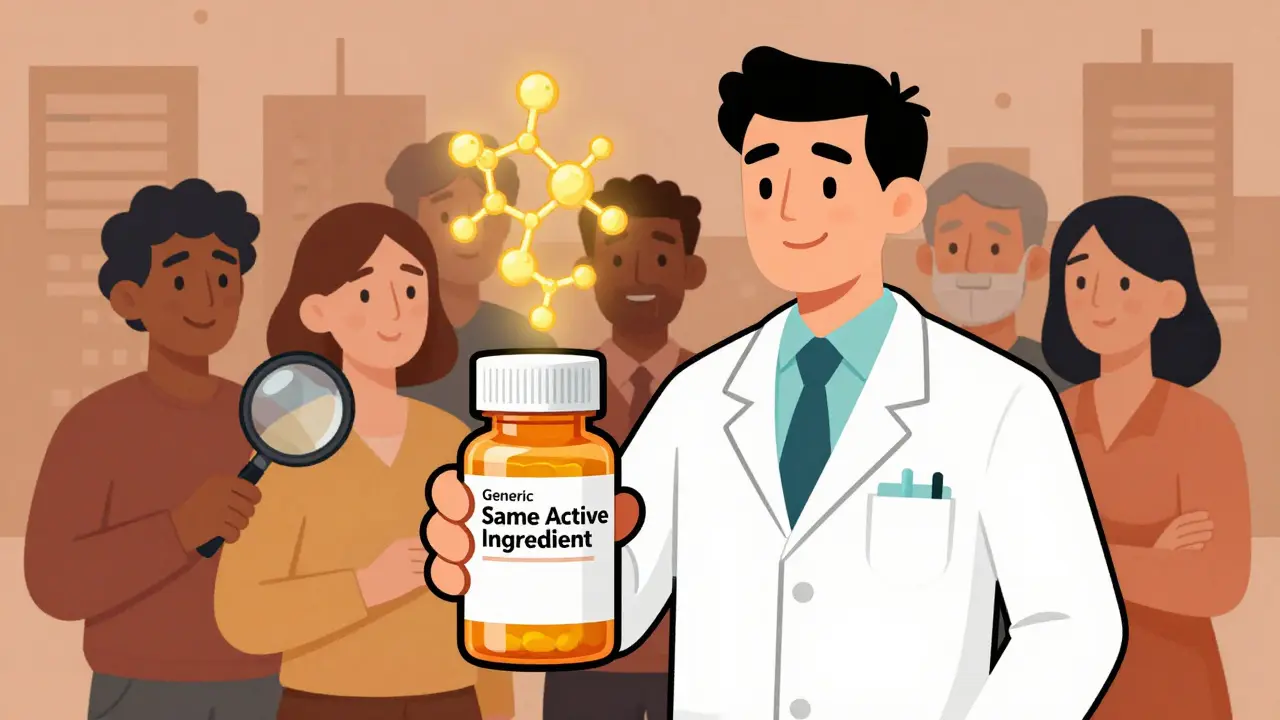
When a pharmacist hands you a pill bottle with a different name than what your doctor wrote on the prescription, it’s natural to pause. Generic medications are just as effective as brand-name drugs-but many patients still hesitate. Why? It’s not because the science is unclear. It’s because the conversation never happened.
Over 90% of prescriptions in the U.S. are filled with generic drugs. They save patients and the healthcare system billions every year. Yet, nearly one in three patients still worry they’re getting something inferior. The truth? The FDA requires generics to match brand-name drugs in active ingredients, dosage, strength, and how the body absorbs them. The difference? Price-generics cost 80% to 85% less. But cost alone doesn’t build trust. Communication does.
Why Patients Doubt Generics-And Where the Doubts Come From
Patients don’t distrust generics because they’re irrational. They’ve been fed myths, sometimes quietly, sometimes loudly. A 2024 study in Frontiers in Drug Safety and Regulation found that 53.7% of patients believed brand-name drugs had better quality. Another 26.8% thought they worked more effectively. These aren’t random fears. They’re shaped by packaging, advertising, and silence from providers.
Look deeper, and you see patterns. Non-white patients are nearly twice as likely as white patients to doubt generics. People with lower education or income levels are more likely to believe generics are less safe. Those on Medicaid are more skeptical than those with private insurance. Why? Often, it’s not about the drug-it’s about how much information they’ve been given.
One major driver? The switch itself. A patient told, “We’re switching you to a generic,” without explanation, feels like an experiment. Reddit threads from r/pharmacy show real stories: one user reported different side effects switching from brand to generic Sertraline. Another said they felt “like a guinea pig.” These aren’t isolated complaints-they’re symptoms of poor communication.
The Silent Hero: The Pharmacist’s Role
Pharmacists are in the best position to fix this. They’re the last healthcare professional a patient talks to before taking a pill. And they’re often the only one who has time to explain.
Research from the Journal of General Internal Medicine shows that 84.7% of patients who received a clear explanation from their pharmacist felt comfortable with the switch. Only 63.2% of those who got no explanation felt the same. That’s a 21.5-point gap-just from a few minutes of conversation.
What works? Simple language. Saying, “This generic has the same active ingredient as your old pill. The FDA tests it to make sure your body gets the same amount of medicine. The only difference? It costs less.” That’s it. No jargon. No charts. Just clarity.
And it’s not just about words. One pharmacy chain, CVS Health, gets a 4.2/5 rating for its generic counseling. Walmart Pharmacy? 3.1/5. Why? The difference isn’t the drugs-it’s the time. Rushed consultations lead to doubt. Calm, clear ones build trust.
Doctors Matter More Than You Think
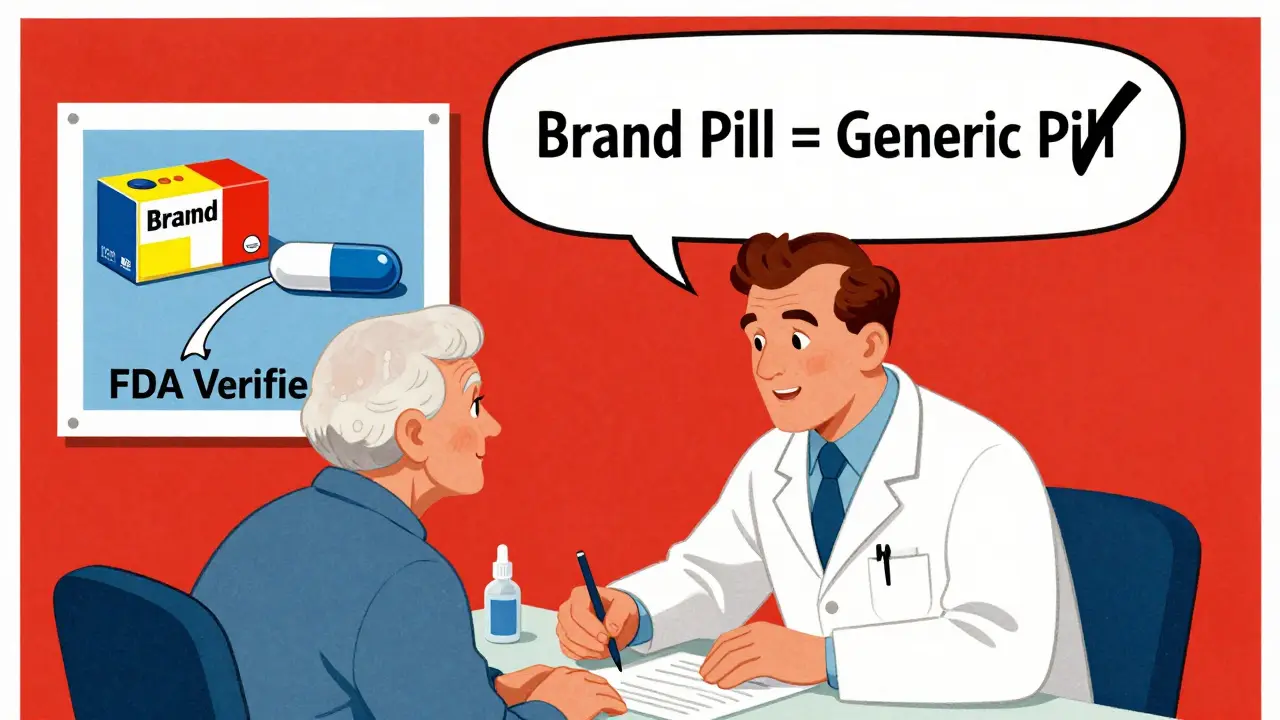
Patients don’t trust pharmacists as much as they trust their doctors. If your doctor says, “This generic is just as good,” the patient believes it. If the doctor doesn’t mention it? Doubt creeps in.
A 2024 PLOS ONE study found that the strongest predictor of patient acceptance of generics wasn’t cost, age, or education. It was the quality of communication from their prescribing physician. Patients who felt their doctor took time to explain were far more likely to use generics-and stick with them.
Doctors don’t need to give a lecture. A single sentence during the visit works: “I’m switching you to this generic because it’s just as effective, and it’ll save you money. The FDA requires it to be identical in how it works.” That’s enough. And when doctors do it, patients notice. They feel respected. They feel involved.
What Patients Actually Fear-And How to Answer
Let’s get specific. What are patients really worried about? Here’s what the data says:
- 24.1% think generics won’t work as well
- 25.7% don’t want to change from what they’re used to
- 29.5% fear new or worse side effects
- 20.8% say they’d rather pay more for peace of mind
Each fear needs a different response.
For “Will it work?”: Show them the FDA’s requirement-bioequivalence. Explain that the drug must deliver 80-125% of the same amount of medicine into the bloodstream as the brand. That’s not a guess. That’s science.
For “I don’t want to change”: Acknowledge it. Say, “It’s normal to feel uneasy switching. Many patients feel the same. But thousands have made this switch without issue.” Then share a real example: “A patient on this same generic for high blood pressure had the same results as when they were on the brand.”
For “I’m scared of side effects”: Don’t dismiss it. Say, “Sometimes, when you switch, your body reacts differently-not because the drug is worse, but because the inactive ingredients (like fillers) are different. That’s why we watch closely the first few weeks.” Then offer follow-up.
For “I’d rather pay more”: Don’t argue. Say, “I get it. You want to feel safe. And you are safe with this. This generic is held to the same standard as the brand. The only difference is the price.”
Tools That Actually Work
Brochures? Most patients say they’re “somewhat helpful.” Videos? Helpful, but not enough on their own. What works best? Personal, timely, tailored talk.
But tools can support it. The FDA’s Generic Drugs: Questions and Answers page answers 50 common concerns with clear, evidence-based replies. Pharmacists can print out a one-pager with key points: “Same active ingredient. Same dosage. Same effect. Different price.”
Some clinics use the Newest Vital Sign test to check health literacy before explaining generics. If a patient struggles with basic medical terms, simplify further. Use analogies: “Think of it like two different brands of aspirin. One costs $1, one costs $5. Both have the same active ingredient. One just has fancier packaging.”
Electronic health records can help too. A pop-up reminder during prescribing: “Consider discussing generic substitution with patient.” It’s small. But it nudges doctors to act.
The Bigger Picture: Why This Matters
Generics aren’t just cheaper. They’re essential. In 2022, they saved the U.S. healthcare system $370 billion. Without them, millions couldn’t afford their prescriptions. But if patients refuse them out of fear, those savings vanish.
It’s not about convincing people to save money. It’s about giving them confidence. Confidence that the system works. Confidence that their doctor and pharmacist have their back. Confidence that the little white pill in the plain bottle is just as powerful as the one in the colorful box.
The data is clear: when patients are informed, they choose generics. When they’re left in the dark, they hold back. The solution isn’t new advertising. It’s not more logos on packaging. It’s conversation. Real, honest, patient-centered talk.
Every time a pharmacist takes two extra minutes. Every time a doctor says one clear sentence. Every time a patient is asked, “Do you have any questions about this change?”-trust grows. And with trust, better health follows.
Are generic drugs really as safe as brand-name drugs?
Yes. The FDA requires generic drugs to meet the same strict standards as brand-name drugs. They must contain the same active ingredient, in the same strength, and deliver the same amount of medicine into the bloodstream. The FDA tests them for bioequivalence-meaning they work the same way in the body. The only differences are in inactive ingredients (like color or filler), which don’t affect how the drug works. Thousands of studies confirm generics are just as safe.
Why do some people have different side effects on generics?
Side effects from generics are rare, but sometimes they happen. That’s usually because the inactive ingredients-like dyes, fillers, or preservatives-are different. These don’t affect how the medicine works, but they can affect how your body reacts. For example, someone allergic to a dye in one version might feel a rash. This isn’t because the generic is weaker or unsafe-it’s just a different formula. If side effects appear after switching, talk to your provider. They can switch you to another generic or back to the brand.
Can pharmacists switch my brand-name drug to a generic without asking me?
In 18 U.S. states, pharmacists can substitute a generic for a brand-name drug without notifying the doctor or patient-unless the prescription says “dispense as written.” But even in those states, best practice is to inform the patient. In 12 states, the doctor must give explicit permission. Regardless of the law, patients should always be told. A simple heads-up like, “I’m giving you a generic version today-it’s the same medicine, just cheaper,” builds trust and reduces anxiety.
Do generics work the same for chronic conditions like diabetes or high blood pressure?
Absolutely. Generics are used daily for chronic conditions like diabetes, high blood pressure, and depression. Studies tracking patients over years show no difference in outcomes between brand and generic versions. For example, a 2023 study of over 100,000 patients on generic blood pressure medication found no increase in hospitalizations or complications compared to the brand. The FDA monitors these drugs closely, especially for conditions where small changes matter.
Why do some doctors still prescribe brand-name drugs?
Sometimes, it’s because the patient has tried generics before and had a bad reaction-even if it was rare. Other times, the drug is complex, like an inhaler or injectable, and the generic version isn’t fully proven to behave the same way. In rare cases, insurance or formulary rules may limit options. But for 90% of prescriptions, a generic is the right, safe, and cost-effective choice. Doctors who avoid generics without reason are missing a chance to help patients afford care.
How can I tell if a generic is right for me?
Ask three questions: 1) Is this the same active ingredient as my current drug? 2) Has it been approved by the FDA? 3) Has anyone else I know switched and had issues? If the answer to the first two is yes, and the third doesn’t raise red flags, it’s likely safe. Talk to your pharmacist or doctor. They can check the FDA’s database or give you a printed fact sheet. Don’t assume-ask. Your health is worth the conversation.


10 Comments
Timothy Haroutunian-21 February 2026
Look, I get it. Generics are cheaper. But let’s be real-when I switched from brand-name Lisinopril to the generic, I started getting this weird headache every afternoon for two weeks. My pharmacist said, 'It’s just the fillers.' Okay. But what if the fillers are causing inflammation? What if they’re laced with something the FDA doesn’t test for? I’m not paranoid. I’m just someone who’s been burned before. I don’t care how many studies say it’s safe-I’ve got my own data, and it’s not pretty.
And don’t get me started on how pharmacists just hand you the bottle like it’s a bag of chips. No explanation. No 'how are you feeling?' No follow-up. It’s like we’re just test subjects in some corporate cost-cutting experiment. The system doesn’t care if you feel like crap. It just wants you to stop complaining and take the damn pill.
I’ve got a friend who went from brand to generic for antidepressants. She went from stable to suicidal in three weeks. They told her it was 'just adjustment.' Bullshit. She switched back. She’s alive today. That’s not a statistic. That’s her life.
So yeah, maybe 90% of people are fine. But what about the 10% who get screwed? Who speaks for them? The FDA? The drug companies? The pharmacy chains that make a killing off this? Not a chance.
Generics aren’t evil. But the way we treat patients who have bad reactions? That’s the real scandal here.
Erin Pinheiro-22 February 2026
so like… i read this whole thing and i’m just sitting here wondering why we even bother with brand names at all if they’re literally the same thing? like… why does one cost 5x more? is it the packaging? the fancy bottle? the little logo that says ‘premium quality’? because if that’s it, then we’re literally paying for marketing. and not even good marketing. just… more ads.
also. i switched to a generic for my blood pressure med and i got this weird metallic taste. i thought i was dying. turned out it was just the fillers. but no one told me that. i was convinced i was gonna lose my tongue. like. why is this not on the label? like a warning? ‘may cause temporary tongue apocalypse’?
also. why do pharmacists always look at me like i’m dumb when i ask questions? like. i’m not a doctor. i’m just trying not to die. is that too much to ask?
Michael FItzpatrick-24 February 2026
There’s something deeply human here, and we’re missing it. We treat medication like a commodity-swap it out like a lightbulb-and wonder why people feel alienated. But medicine isn’t just chemistry. It’s ritual. It’s routine. It’s the quiet moment before you swallow that pill, the hope that it’ll make you whole again.
When you swap a pill without context, you’re not just changing the label-you’re breaking a promise. The promise that someone has your back. That your health matters enough to be explained, not just distributed.
Pharmacists? You’re the unsung heroes. You’re the last person before the bottle hits the medicine cabinet. A simple ‘This is the same medicine, just cheaper’ doesn’t just reduce anxiety-it rebuilds trust. And trust? That’s the real active ingredient.
Doctors? Don’t outsource your empathy. Say it in the exam room. One sentence. One moment. That’s all it takes. And patients? They’ll remember it. Not because it was profound. But because you made them feel seen.
This isn’t about cost savings. It’s about dignity. The dignity of being told the truth. The dignity of being treated like a person, not a line item.
Let’s stop optimizing for efficiency and start designing for humanity. Because pills don’t heal people. Trust does.
Brandice Valentino-25 February 2026
Oh please. Another ‘let’s talk about generics’ lecture. Like this is news? I’ve been on generics since 2017. I’ve had 7 different ones. I know the drill. You get the pill. You swallow it. You pray. That’s it. The FDA? Please. They’re basically the pharmaceutical industry’s HR department.
And don’t get me started on pharmacists. Half of them can’t even pronounce ‘bioequivalence.’ One guy told me the generic was ‘the same but with extra vitamins.’ I didn’t correct him. I just took the bottle and left. I’m not here to teach your interns.
Also. Why is everyone acting like this is some groundbreaking revelation? Like we didn’t already know that the only difference is the color of the pill and the price tag? I’m not impressed. I’m just tired.
And for the love of god, stop using phrases like ‘the system’ like we’re all in some dystopian novel. It’s capitalism. It’s not a mystery. It’s just greed with a white coat.
Larry Zerpa-26 February 2026
Let’s deconstruct this. The article says patients distrust generics because of poor communication. But what if the distrust isn’t irrational? What if it’s *rational*? Because the FDA doesn’t require generics to be identical in *inactive* ingredients-and those can trigger immune responses, especially in autoimmune patients. And yet, the system treats them as interchangeable.
Here’s the truth: generics are approved based on a single bioequivalence study with 24 healthy adults. That’s it. One study. One group. No elderly. No pregnant women. No people with kidney disease. No polypharmacy patients. And yet, we’re told to trust this for chronic conditions?
And the claim that ‘84.7% of patients felt comfortable after a pharmacist’s explanation’? That’s not a measure of safety. That’s a measure of resignation. People say ‘fine’ because they can’t afford to say no.
Also-why is no one talking about the fact that 40% of generic manufacturers are overseas? With zero FDA inspections in 2022? That’s not a gap. That’s a chasm.
This article is a PR piece disguised as public health. It’s not about trust. It’s about control. And I’m not buying it.
Gwen Vincent-26 February 2026
I work in a community clinic, and I’ve seen this firsthand. A 72-year-old woman came in last week, trembling, because her blood pressure med switched to a generic. She said, ‘I’ve been on this blue pill for 12 years. Now it’s white. I think they gave me the wrong one.’
We sat down. I showed her the bottle. I told her the active ingredient was the same. I even pulled up the FDA page on my tablet. She cried. Not from fear. From relief.
It’s not about the science. It’s about the silence. When someone takes the time to sit with you, to say ‘I see you, and I’m not rushing you,’ that’s when trust happens.
Generics aren’t magic. But kindness? That’s a medicine too. And it’s free.
Nandini Wagh-26 February 2026
Oh honey. You really think explaining the FDA’s bioequivalence standards will fix this? Let me tell you what actually happens: a woman in rural Alabama gets her Medicaid refill, sees a different pill, calls her daughter, who calls her son-in-law who’s a nurse, who calls the pharmacy, who says ‘it’s fine.’ Then the woman takes it. And two days later, she’s dizzy. She doesn’t know if it’s the pill, the stress, the heat, or the fact that her insulin is running low.
So now she stops taking *everything*. Because the system didn’t give her a reason to trust one thing over another.
It’s not about communication. It’s about *consistency*. You can’t fix a system that treats people like variables with a 5-minute script and call it ‘patient-centered care.’
Also-why are we still using ‘FDA-approved’ like it’s a stamp of divine approval? The FDA approves *some* generics with data from manufacturers who’ve never been inspected. That’s not safety. That’s paperwork.
Holley T-27 February 2026
Let’s be honest-this whole thing is a farce. The FDA doesn’t require generics to be bioequivalent across all populations. Just in healthy young adults. So what happens when an elderly diabetic with three other meds switches to a generic? No one studies that. No one cares.
And the ‘one sentence from the doctor’ solution? That’s a Band-Aid on a hemorrhage. You think a 10-minute visit with a doctor who’s already behind by 47 patients is going to include a nuanced discussion about fillers and absorption curves?
Meanwhile, the real issue is that 70% of generic manufacturers are in India and China, and the FDA inspects less than 2% of those facilities. So yes, the pill might be ‘the same’ on paper. But what’s in it? Who knows?
And don’t get me started on the fact that brand-name companies often *make* the generic version. So we’re not saving money. We’re just paying the same company twice under different labels.
This isn’t about trust. It’s about transparency. And we’re not even close.
Ashley Johnson-28 February 2026
EVERY TIME I TAKE A GENERIC I GET A RASH. EVERY TIME. I’VE BEEN TO THREE DOCTORS. THEY ALL SAY ‘IT’S JUST A REACTION TO FILLERS.’ BUT WHAT IF THE FILLERS AREN’T LISTED? WHAT IF THEY’RE ADDING STUFF THEY’RE NOT SUPPOSED TO? WHAT IF THE FDA IS LYING? WHAT IF THE PILL ISN’T EVEN THE SAME DRUG? I’VE SEEN THINGS. I KNOW THINGS.
MY COUSIN TOOK A GENERIC FOR THYROID AND GOT A TUMOR. THEY SAID IT WAS ‘COINCIDENCE.’ I KNOW BETTER.
THEY WANT US TO SWITCH BECAUSE THEY’RE MAKING MONEY. THE PILL IS THE SAME. BUT THE COMPANY ISN’T. AND THAT’S WHERE THE TRICK IS.
WHY DON’T WE JUST STICK WITH BRANDS? THEY’RE NOT THAT EXPENSIVE. I’D RATHER PAY MORE AND NOT DIE.
tia novialiswati- 2 March 2026
Thank you for writing this. 💙
I’m a pharmacy tech, and I’ve had patients cry because they were scared to switch. One lady said, ‘I’ve been on this pill since my husband passed. I don’t want to change anything.’ I didn’t push. I just sat with her. We talked about him. Then I showed her the FDA chart. She held my hand. We cried a little. Then she took it.
It’s not about the science. It’s about the heart.
Every time you take two minutes to explain? You’re doing more than dispensing medicine. You’re holding space.
Keep doing this work. You’re changing lives.
And if you’re a patient reading this? You deserve to be heard. Ask questions. Demand answers. You’re not being difficult-you’re being brave.