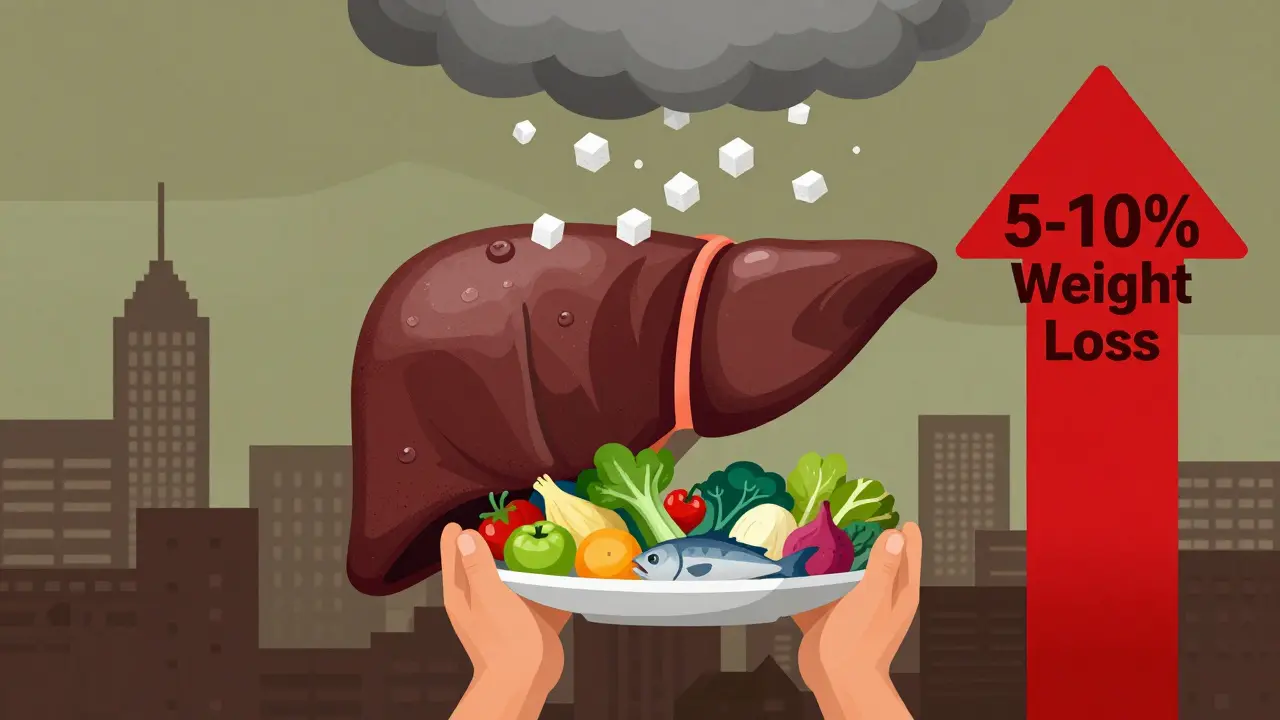
Non-alcoholic fatty liver disease (NAFLD), now called MASH (Metabolic Dysfunction-Associated Steatohepatitis), isn’t just about having a little extra fat in your liver. It’s a silent, growing problem affecting nearly 15 million adults in the U.S. alone. And the scary part? It can sneak up on you until it’s too late - leading to cirrhosis, liver failure, or even cancer. The good news? The most powerful tool you have isn’t a pill. It’s your plate, your movement, and your daily choices.
Why Losing Weight Changes Everything for Your Liver
Your liver doesn’t like fat. When you eat too many refined carbs, sugars, and saturated fats, your liver starts storing excess energy as fat. That’s normal - up to a point. But when fat builds up beyond 5% of your liver’s weight, you’ve crossed into NAFLD. And if inflammation kicks in? That’s MASH.
Here’s the hard truth: no medication works as well as losing weight. Studies show that shedding just 5% of your body weight cuts liver fat significantly. Go past 10%, and you can actually reverse scarring. That’s not a guess. That’s from real liver biopsies. A 2022 study from the American Association for the Study of Liver Diseases found that people who lost 10% or more saw measurable improvement in fibrosis - the kind of damage that leads to cirrhosis.
But here’s the catch: most people can’t stick with it. One three-year study showed that fewer than one-third of people managed to lose even 5%. And only a quarter of those kept it off. That’s why it’s not just about willpower. It’s about strategy.
The Diet That Actually Reverses Liver Fat
Forget crash diets. The Mediterranean diet isn’t trendy - it’s backed by science. A meta-analysis of clinical trials showed that people following this eating pattern had:
- Significant drops in ALT (a key liver enzyme), with p-values under 0.001
- Reduced liver fat (p = 0.02)
- Lower liver stiffness (p = 0.01), meaning less scarring
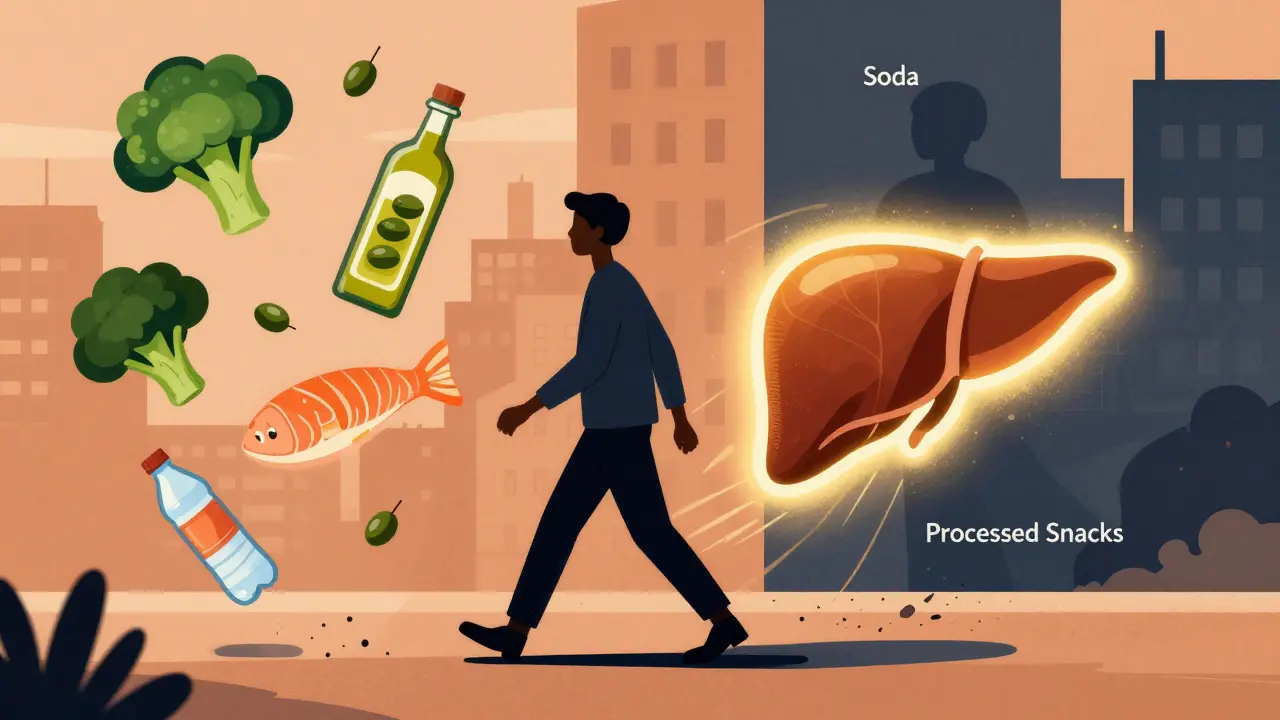
What does this look like in real life? More vegetables, fruits, beans, nuts, olive oil, and fatty fish like salmon. Less sugar, white bread, fried food, and processed snacks. You don’t need to go keto or vegan. Just swap out the bad stuff for real food.
Portion control matters too. If you’re overweight, aim for a daily calorie deficit of 500-1,000 calories. That means losing 1-2 pounds per week - slow, steady, and sustainable. Mayo Clinic says this is the sweet spot. Too aggressive? You’ll burn out. Too slow? You’ll lose momentum.
And yes, sugar is the enemy. Fructose - the kind in soda, juice, candy, and even “healthy” granola bars - gets turned into liver fat faster than almost any other carb. Cutting it out is one of the fastest ways to shrink liver fat.
Exercise Isn’t Optional - It’s Medicine
You don’t need to run a marathon. You don’t even need to go to the gym. But you do need to move - and move often.
The recommendation? At least 150 minutes of moderate activity per week. That’s 30 minutes, five days a week. Brisk walking counts. Cycling. Swimming. Even gardening. A 2023 Mayo Clinic review confirmed that this level of activity reduces liver fat and improves insulin sensitivity - two big drivers of MASH.
And here’s something most people don’t know: strength training helps too. Lifting weights or doing bodyweight exercises two to three times a week builds muscle. More muscle means your body burns more calories - even when you’re sitting still. That’s key for long-term weight control.
One study found that people who combined diet with exercise lost 20% more liver fat than those who only dieted. Movement doesn’t just burn calories. It tells your liver to stop storing fat and start burning it.
The New Medication: Semaglutide (Wegovy) and What It Really Does
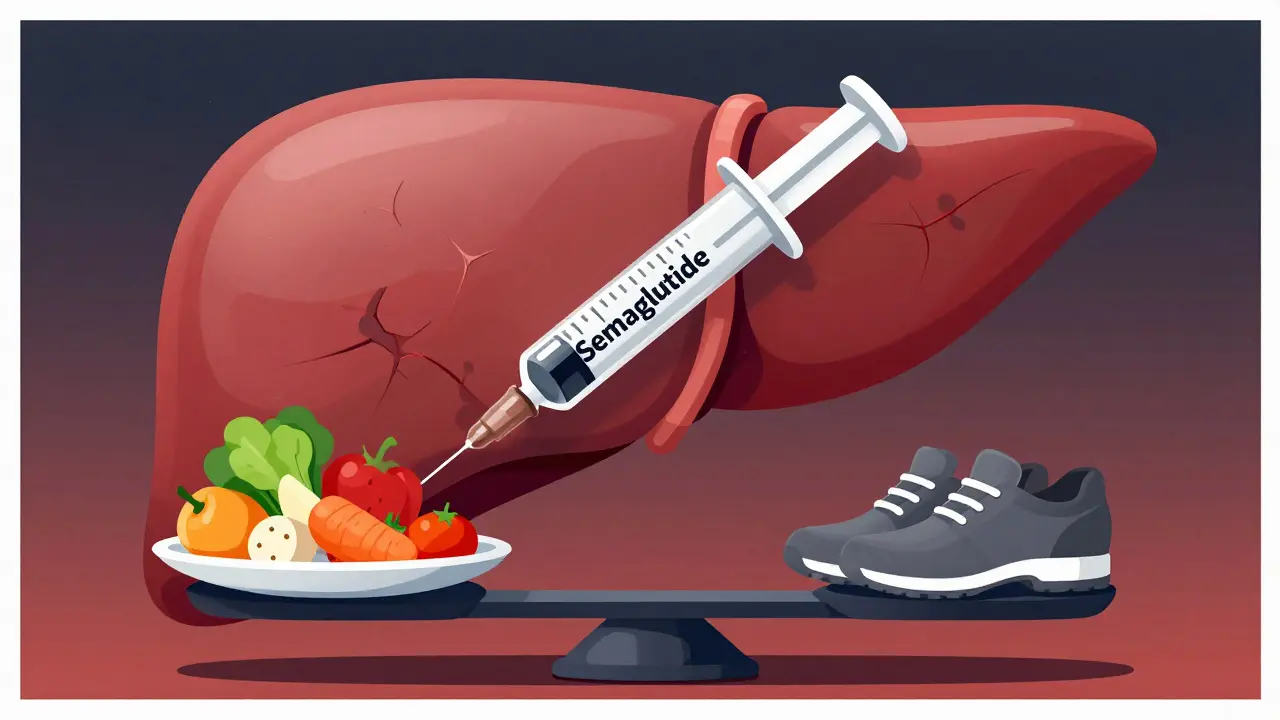
In August 2025, the FDA gave its first-ever approval to a drug specifically for MASH: semaglutide (Wegovy). This isn’t just another weight-loss pill. It’s the first medication approved to treat liver scarring in adults with moderate-to-advanced fibrosis.
How does it work? Semaglutide mimics a natural hormone called GLP-1. It slows digestion, reduces appetite, and helps your body use insulin better. In clinical trials, nearly 90% of people stayed on it for over a year. Two-thirds saw less liver inflammation. More than one-third had less scarring. A third improved in both.
But here’s the reality check: it’s expensive. Without insurance, Wegovy costs about $1,350 a month. That’s 30 to 300 times more than generic metformin, which some doctors still prescribe despite weak evidence of liver benefit. And while Wegovy’s approval is huge, insurance coverage is still patchy - only about 40% of commercial plans cover it for MASH right now.
Is it better than diet and exercise? The evidence says: not necessarily. Most head-to-head studies show that lifestyle changes alone can match or even beat the results of these drugs. Semaglutide helps people stick with weight loss - especially those who’ve tried and failed before. But it’s not a magic bullet. It’s a tool. And it works best when paired with real food and movement.
What About Other Medications?
Metformin? It’s cheap, widely used for diabetes, and has been studied for NAFLD for years. But the data is weak. It might help a little with insulin resistance, but it doesn’t reliably reduce liver fat or fibrosis.
Orlistat? It blocks fat absorption, so you lose weight. But there’s no solid proof it improves liver health. Plus, the side effects - oily stools, gas - make it hard to stick with.
SGLT2 inhibitors (like empagliflozin)? These diabetes drugs help the kidneys flush out sugar. Early studies show they reduce liver fat. But they’re not yet approved for MASH. More research is needed.
GLP-1 agonists like semaglutide are the only class with strong, consistent evidence for both weight loss and liver repair. And they’re the only ones with FDA approval for MASH.
Real-World Challenges - And How to Get Past Them
Most people hit a wall around the 6-month mark. Weight loss slows. Cravings come back. Motivation drops. That’s normal. It’s not failure. It’s biology.
Here’s how to keep going:
- Track what you eat - not obsessively, but enough to spot patterns. Use a free app like Cronometer or MyFitnessPal for a week. You’ll be surprised.
- Find your support - a dietitian, a fitness coach, or even an online group. People who have accountability lose more and keep it off longer.
- Manage stress and sleep - high cortisol and poor sleep increase belly fat and liver fat. Aim for 7-8 hours. Try meditation or deep breathing.
- Don’t quit because of a plateau - your body adjusts. Keep eating well and moving. The next drop is coming.
And if you’ve tried everything and still can’t lose weight? Talk to your doctor. You’re not alone. Medications like semaglutide exist because lifestyle changes are hard - and they’re not meant to be done alone.
The Bottom Line
You don’t need a miracle. You need consistency. Losing 5-10% of your body weight is the single most effective thing you can do for your liver. Diet and exercise are still the gold standard. Semaglutide is a breakthrough - but only if you can access it and use it right.
Start small. Swap one sugary drink for water. Walk 20 minutes after dinner. Add a serving of vegetables to lunch. These aren’t big changes. But they add up. And they protect your liver - one day at a time.


12 Comments
matthew runcie-22 March 2026
Honestly this post says everything I needed to hear without being preachy. Just swap one soda for water and take a walk after dinner. Small stuff adds up. I started doing that last month and my doctor said my liver enzymes are finally normal. No magic pills needed.
shannon kozee-23 March 2026
The Mediterranean diet works because it’s not a diet. It’s a way of eating that doesn’t feel like deprivation. Olive oil, beans, fish, veggies - that’s just good food. No need to count macros or cut out carbs entirely.
Shaun Wakashige-23 March 2026
Semaglutide costs more than my rent 😅
Solomon Kindie-23 March 2026
People think weight loss is about willpower but its really about biochemistry and access to real food and time to move your body which most people dont have because they work two jobs and live in food deserts so yeah the science is cool but the system is broken
Johny Prayogi-25 March 2026
I lost 14% of my body weight in 6 months just by walking 30 mins a day and cutting out sugary coffee. No gym. No supplements. Just consistency. Semaglutide? Maybe for some. But for most? Just move and eat real food. 🏃♂️🥗
Desiree LaPointe-27 March 2026
Oh look, another ‘lifestyle changes work’ manifesto. How quaint. Meanwhile, the pharmaceutical industry is quietly funding studies that make semaglutide look like a miracle. Funny how the ‘gold standard’ always happens to be the thing you can’t afford.
Jackie Tucker-28 March 2026
The irony is thick here. We’re told to ‘eat real food’ while the entire food system is engineered to make that impossible. Processed food is cheaper, more accessible, and designed to hijack dopamine. The burden of health is placed on the individual while the architecture of disease is left untouched. How poetic.
Allison Priole-29 March 2026
I used to think I had to do everything perfect - no sugar, no carbs, 1 hour of cardio daily. Then I just started adding one veggie to every meal and walking after dinner. Didn’t even track it. Lost 8% in 5 months. My liver feels lighter. My mood too. You don’t need to overhaul your life. Just nudge it a little. Every day. That’s all it takes.
Casey Tenney-30 March 2026
If you’re still drinking juice or eating ‘healthy’ granola bars, you’re lying to yourself. Fructose is poison for your liver. Stop pretending you’re being good. Just stop.
Sandy Wells-31 March 2026
The article mentions a 2022 study but fails to cite the journal or DOI. Without verifiable sources, this reads more like a blog post than medical advice. Credibility matters.
Chris Dwyer- 1 April 2026
You got this. Seriously. Even if you only lose 3% this time, that’s still 3% less stress on your liver. Every step counts. I’ve been there - stuck, frustrated, overwhelmed. Then I just started with one change. One. Then another. You don’t need to be perfect. Just show up. I’m rooting for you.
Thomas Jensen- 1 April 2026
They don't want you to know this but the real cause of NAFLD is glyphosate in your food and 5G radiation messing with your mitochondria. Big Pharma just sells you semaglutide to keep you dependent. The FDA is in on it. Your liver isn't broken - it's being poisoned by the system. Wake up.