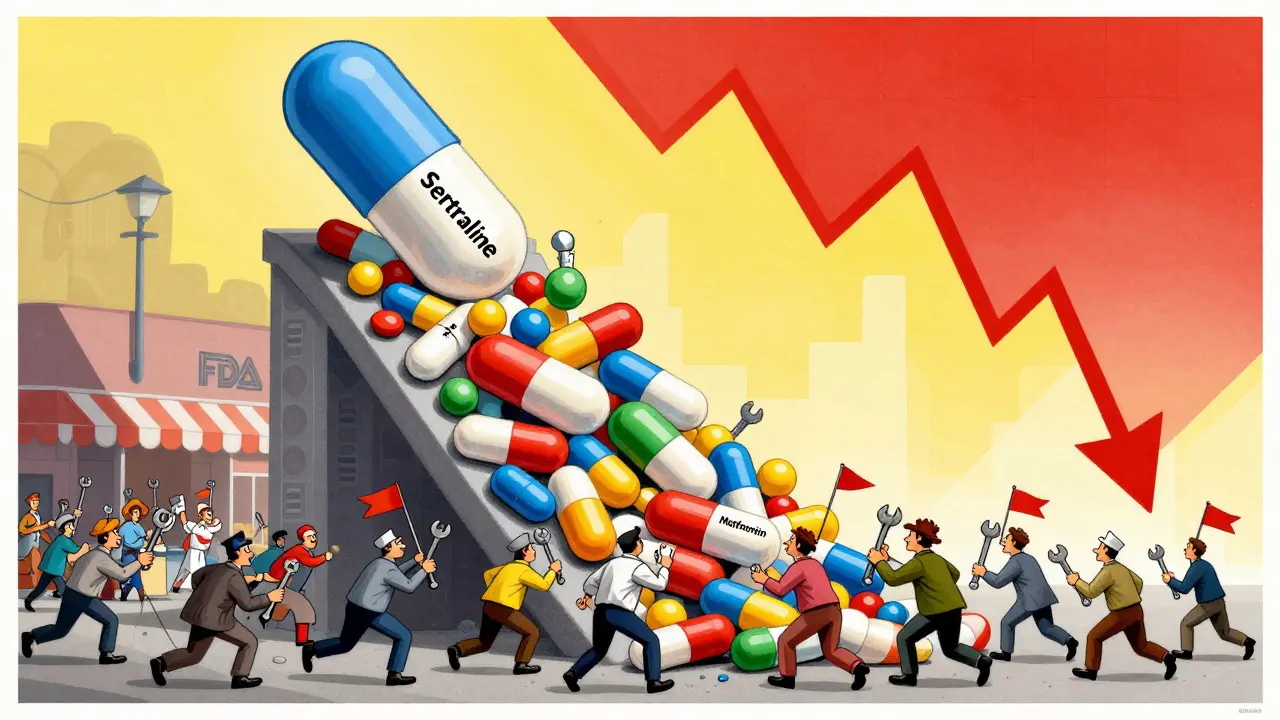
When you pick up a prescription for generic sertraline or metformin, you probably don’t think about how the price got so low. It’s not magic. It’s not charity. It’s the result of a deliberate, decades-long system built to let competition do the work. Governments don’t set prices for generic drugs the way they might for a new cancer drug. Instead, they create the conditions where prices drop naturally - and they’ve been doing it so well that direct price controls are almost never needed.
Why Generic Drugs Don’t Need Price Caps
Generic drugs make up 90% of all prescriptions filled in the U.S., but they account for just 23% of total drug spending. That’s not a fluke. It’s the outcome of a system designed to drive prices down fast. Once a brand-name drug’s patent expires, multiple manufacturers can jump in. The first generic maker might price at 30% of the brand’s cost. By the time five or six companies are selling the same pill, prices often fall to 10-15% of the original. In some cases, they drop 90% within two years.The FDA says that when three or more generic versions are available, prices stabilize at a fraction of what they were. There’s no need for a government agency to step in and say, "This pill can’t cost more than $2." The market already did it. That’s why the Medicare Drug Price Negotiation Program, created in 2022, explicitly excludes generics. The Department of Health and Human Services made it clear: generics already have enough competition to keep prices low.
The Hatch-Waxman Act: The Engine Behind Generic Competition
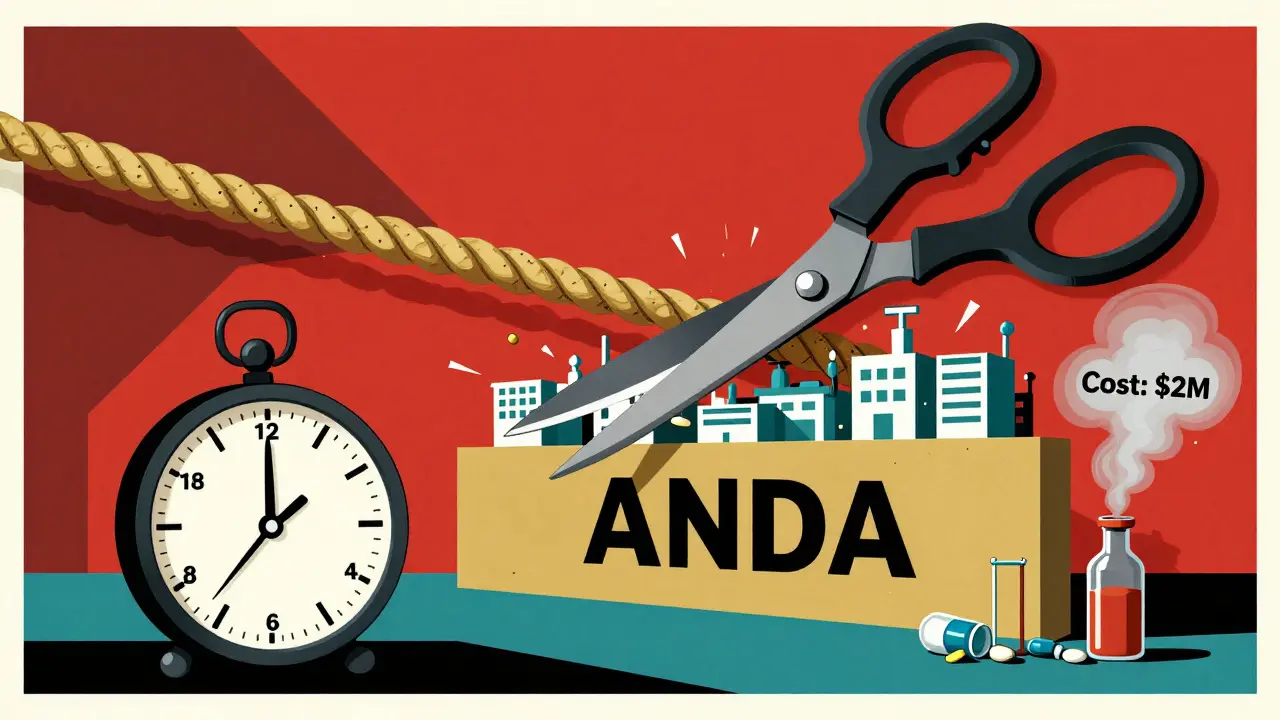
The real hero here isn’t a politician - it’s the Hatch-Waxman Act of 1984. Before this law, a generic drug maker had to run the same expensive clinical trials as the original brand. That meant only big companies could afford to make generics. The law changed that. It created the Abbreviated New Drug Application (ANDA) process. Now, generic companies only need to prove their pill is bioequivalent - it works the same way in the body. No need to retest safety or effectiveness.This cut the cost of bringing a generic to market from $2.6 billion to just $2-3 million. Suddenly, dozens of small companies could enter the game. The FDA approved just 200 generics a year in the 1980s. In 2023, they approved 1,083. That’s not just growth - it’s an explosion of competition.
How the FDA Keeps the Pipeline Flowing
Approval speed matters. The longer it takes for generics to hit the market, the longer the brand-name drug keeps its monopoly. That’s why the FDA launched the Generic Drug User Fee Amendments (GDUFA) in 2012 and renewed it in 2022 with $750 million in industry fees. The goal? Cut approval time from 18 months to 10.They hit it. In 2023, 92% of priority generic applications got a decision within 10 months. That’s a huge win. But it’s not perfect. Complex generics - drugs with tricky formulations like inhalers, injectables, or extended-release pills - still take longer. Only 38% of those met the 10-month target. To fix this, the FDA created a special submission template in late 2023. Early results show a 35% drop in review time for these harder-to-make drugs.
You can track every application in real time on the FDA’s Generic Drug User Fee Public Dashboard. If your favorite generic hasn’t come out yet, you can see exactly where it is in the queue.
The FTC: Watching for Cheaters
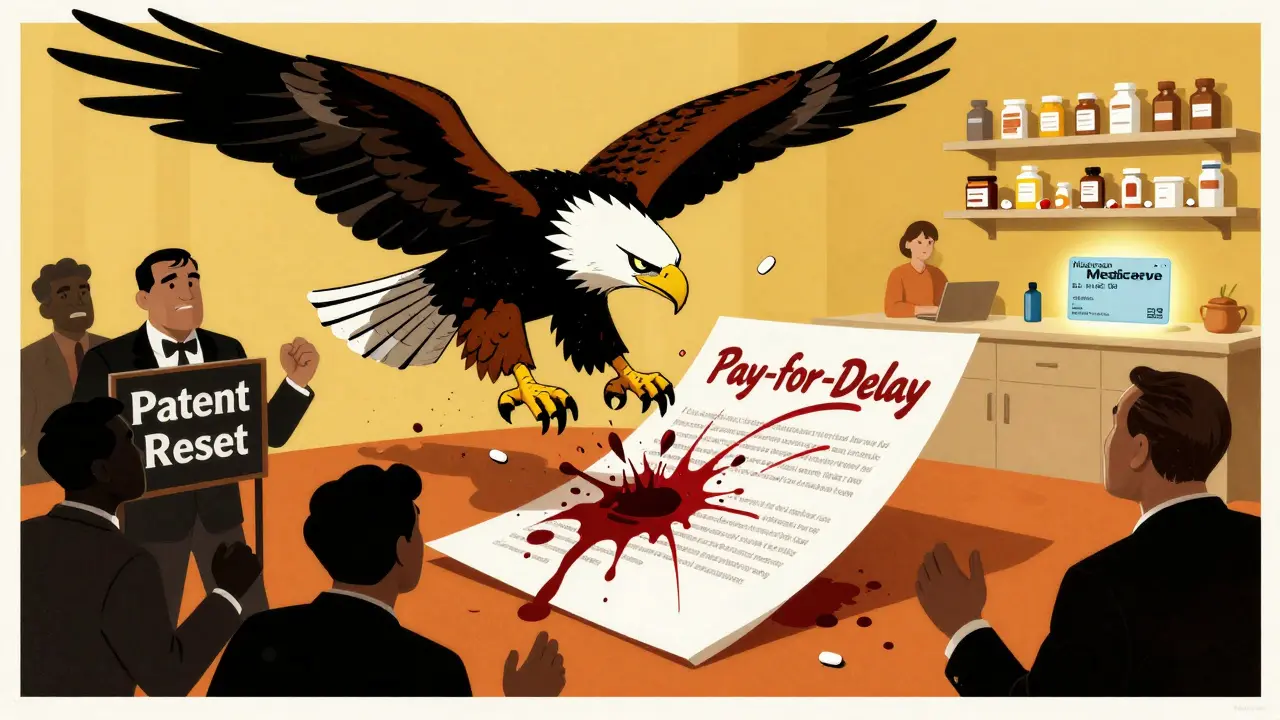
Competition only works if everyone plays fair. That’s where the Federal Trade Commission comes in. For years, brand-name companies paid generic makers to delay their entry. These "pay-for-delay" deals kept prices high. In 2023 alone, the FTC challenged 37 of these agreements. One case involved a heart drug where the brand paid a generic maker $100 million to stay off the market for two extra years.When those deals are blocked, consumers save billions. The FTC estimates that stopping just one pay-for-delay deal can save $100 million in a single year. In 2023, they recovered $1.2 billion in consumer redress from anti-competitive practices. They also blocked the proposed merger between Teva and Sandoz - two of the world’s biggest generic makers - because it would have reduced competition for 13 essential drugs.
Why Price Controls on Generics Would Backfire
You might think, "Why not just cap prices like they do in Canada or Germany?" The numbers say it’s not worth it. A 2024 Congressional Budget Office analysis found that applying international price benchmarks to generics would save Medicare only $2.1 billion a year - just 0.4% of total generic spending. Meanwhile, negotiating prices for just 15 high-cost brand-name drugs like Ozempic could save $158 billion.Stanford Medicine’s 2024 white paper put it simply: extending price negotiations to generics would save $1.2 billion annually. That’s less than what one new cancer drug might cost. Meanwhile, the Academy of Managed Care Pharmacy says direct price regulation could actually hurt access. If the government sets prices too low, manufacturers stop making the drug. That’s not hypothetical.
In 2024, 18% of hospital pharmacists reported shortages of critical generics because prices had fallen below production costs. Forty-three percent said manufacturers had discontinued products because they couldn’t make a profit. That’s the hidden cost of over-regulation. You don’t want to end up with a drug that’s cheap - but unavailable.
What Patients Actually Pay
Most people don’t notice these policy battles - but they feel the results. The 2024 KFF Consumer Survey found that 76% of Medicare Part D users pay $10 or less for their generic prescriptions. Only 28% pay that little for brand-name drugs. Eighty-two percent of generic users say their meds are affordable. Only 41% of brand-name users say the same.But there are outliers. On Reddit, users post stories about sertraline jumping from $4 to $45 a month. These aren’t lies - they’re real. But they’re rare. The FDA’s 2023 Drug Shortage Report says only 0.3% of generic drugs see these kinds of spikes. Usually, it’s because one manufacturer stopped making it and no one else stepped in fast enough. That’s a supply chain issue, not a pricing issue.
The Bigger Picture: U.S. vs. the World
The U.S. has the most competitive generic market in the world. On average, there are 14.7 manufacturers per generic drug here. In Europe, it’s 8.2. In Japan, it’s 5.3. That’s why U.S. generic prices are lower - not because of government control, but because of sheer number of players.Even though the U.S. uses 42% of the world’s generic drugs by volume, it accounts for only 29% of global spending. That’s the power of competition. Other countries use price controls, but they often pay more per pill because they have fewer manufacturers. The U.S. pays less because it has more.
What’s Next for Generic Drug Pricing?
The focus now isn’t on setting prices - it’s on removing barriers. The FDA’s 2024-2026 plan is pushing harder on complex generics and blocking "product hopping" - when brand companies slightly change a drug just to reset the patent clock. The CMS proposed rule in April 2024 aims to stop insurance plans from requiring prior authorization for generics. That’s a huge deal. Right now, some plans make patients jump through hoops for a $3 pill, even though it’s cheaper than the brand.These changes could save beneficiaries $420 million a year. That’s not because the government set a price. It’s because they removed friction. The system works when competition is free, fast, and fair. That’s the goal. And so far, it’s working.


12 Comments
Marilyn Ferrera-30 December 2025
Competition isn't just market magic-it's policy architecture. The Hatch-Waxman Act didn't just lower barriers; it redefined what 'affordable' means. And yet, we still treat generics like an afterthought in healthcare reform.
It's not that we don't know how to fix this-it's that we refuse to protect the system we already built.
Darren Pearson-31 December 2025
One must acknowledge the elegant efficiency of the American regulatory framework in this domain. The market-driven disincentive to monopolistic pricing, facilitated by the ANDA pathway, represents a triumph of classical economic theory applied with surgical precision.
Contrast this with the European model-where bureaucratic price controls induce stagnation and chronic shortages. The U.S. system, though imperfect, operates on the principle of emergent order, not top-down dictation.
Stewart Smith-31 December 2025
So let me get this straight-we spent 40 years building a system where a $3 pill costs $3 because 14 companies fight over it… and now people are mad because one guy got rich off a heart drug for 10 years?
Meanwhile, my grandma pays $4 for metformin and still says, 'I wish they'd make more of these.'
Stop trying to fix what ain't broke, and start fixing the 0.3% that actually break.
Retha Dungga- 2 January 2026
USSR tried price control 🤡 now we got free market magic 🤞💸 generic drugs cheap like street food in Mumbai 🌶️🇺🇸
Jenny Salmingo- 2 January 2026
I just take my pills. I don’t know all the laws. But I know when my bottle lasts longer and costs less. That’s good enough for me.
My neighbor says her sertraline went up last month. I told her to check the pharmacy next town over. She did. Saved $22.
That’s the system working.
Aaron Bales- 3 January 2026
If you’re worried about shortages, stop blaming the market and start fixing the supply chain.
It’s not the price that’s the problem-it’s the consolidation, the single-source manufacturing, the lack of backup suppliers.
Let competition thrive. But require diversification. That’s not regulation. That’s common sense.
Kayla Kliphardt- 4 January 2026
Wait-so the FDA’s dashboard shows real-time approval status… but only for certain generics? What about the ones that get stuck in limbo for 2+ years?
Is that data actually accessible to patients, or just to industry insiders?
I’ve seen drugs sit for 18 months with ‘Under Review’ forever. That’s not efficiency. That’s opacity.
John Chapman- 5 January 2026
Y’all are acting like the FDA is some saintly angel 🙏
They approve 1,000 generics a year but still let one company corner 70% of the market for a 15-year-old drug because ‘it’s complicated’?
And we’re supposed to cheer because it’s $3 instead of $30? Bro, it should be $1.50.
Competition isn’t free if the gatekeepers are still holding the keys.
Urvi Patel- 5 January 2026
Western medicine always pretends it's fair but the real winners are the ones who control the patents and the FDA approvals 😏 USA thinks it's genius but it's just exploitation dressed as capitalism
anggit marga- 6 January 2026
You think America is the best because you have more generic makers? Lol. Nigeria makes cheaper medicine with no FDA and no billion-dollar labs. We just make what works. You overthink everything until it breaks.
Joy Nickles- 7 January 2026
ok so the system works… until it doesn't
my dad's generic blood pressure med went from $5 to $47 in 6 months bc the only maker stopped making it and no one else was approved yet
the FDA dashboard says 'pending' for 14 months
sooo… competition? more like a monopoly with a waiting list 🤡
Emma Hooper- 8 January 2026
Let’s be real-this whole system is a beautiful, chaotic, slightly broken masterpiece.
It’s like a food truck wars where 20 vendors sell the same taco, but one guy’s got a secret spice blend and the health inspector’s got a vendetta.
Most days? You get a $2 taco that’ll save your life.
Some days? You get a taco truck that vanished overnight, and the only one left charges $15 because ‘supply chain issues.’
It’s messy. It’s wild. It works… mostly.
And yeah, we should fix the gaps.
But don’t you dare turn this into a government-run taco stand.