When you hear that hepatitis C has been cured, it’s easy to assume everything’s fine now. You’ve beaten the virus. Your liver is clean. You can stop worrying. But here’s the truth: liver cancer risk after SVR doesn’t vanish - not even close. Even after your blood tests show no trace of hepatitis C virus, your liver might still be carrying hidden damage that could lead to cancer. And if you had advanced fibrosis or cirrhosis before treatment, skipping follow-up scans could be dangerous.
What SVR Really Means - And What It Doesn’t
Sustained Virologic Response (SVR) means the hepatitis C virus is undetectable in your blood 12 or 24 weeks after finishing treatment. It’s not just a win - it’s a near-perfect cure. Direct-acting antivirals (DAAs) now cure more than 95% of people, even those with advanced disease. For many, this is life-changing. Fatigue fades. Liver enzymes drop. The fear of cirrhosis or liver failure lifts. But SVR doesn’t mean your liver is back to normal. Think of it like quitting smoking: your lungs heal, but if you smoked for 20 years, your cancer risk doesn’t disappear overnight. The same applies to your liver. Years of inflammation and scarring leave behind changes that can still turn cancerous, even without the virus.The Numbers Don’t Lie - Risk Is Still There
Studies show SVR reduces liver cancer risk by about 71%. That sounds impressive - and it is. But let’s put it in real terms. If you had cirrhosis before treatment, your chance of developing liver cancer after SVR is still around 2.1 to 2.3 cases per 100 people each year. That’s not rare. That’s high enough to warrant regular checks. Compare that to someone with no liver damage before treatment - their risk after SVR is extremely low. But if you had advanced fibrosis (F3) or cirrhosis (F4), you’re still in the danger zone. The liver doesn’t magically reset. Scar tissue doesn’t vanish. Some cells that turned abnormal during years of viral attack may still carry the potential to become cancerous.Fibrosis Is the Real Predictor - Not Just the Virus
The key to knowing if you need ongoing surveillance isn’t whether you had hepatitis C. It’s how much scarring your liver had before treatment. Two tools are used to measure this: FibroScan (transient elastography) and the FIB-4 score. After SVR, if your FibroScan reading is above 11.2 kPa, your risk of liver cancer stays elevated. If your FIB-4 score is above 3.25, you’re still at risk. These numbers aren’t guesses - they’re backed by large studies across Europe, North America, and Asia. They’re the reason experts say: if you had advanced scarring, keep getting screened. Some doctors will tell you, “You’re cured - no need for scans anymore.” But that’s not what the data says. A 2023 JAMA Network Open study found that cirrhotic patients who achieved SVR still had liver cancer rates nearly half of those who never got treated. That’s not a small difference - it’s a reason to stay vigilant.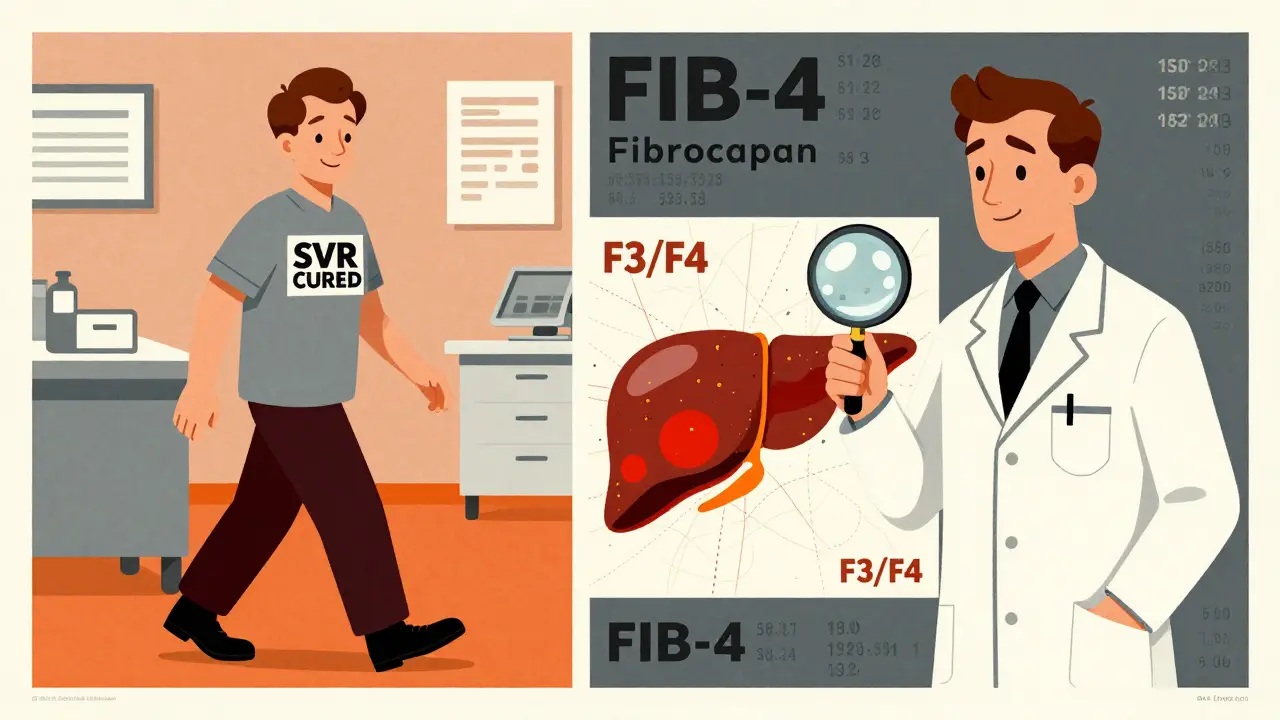
Why Guidelines Clash - Europe vs. America
Here’s where things get messy. In Europe, guidelines from the European Association for the Study of the Liver (EASL) say: if you had F3 or F4 fibrosis, keep getting ultrasound scans every six months - forever. In the U.S., the American Association for the Study of Liver Diseases (AASLD) says: only patients with cirrhosis (F4) need ongoing screening. Those with advanced fibrosis (F3) can stop. Why the difference? It comes down to risk tolerance and practicality. European experts worry that F3 fibrosis can be misdiagnosed - what looks like F3 might actually be early cirrhosis. And missing a single liver cancer case can be deadly. American experts argue that F3 patients often see fibrosis improve after SVR, and the cancer risk is too low to justify lifelong scans. But here’s the catch: even AASLD admits that if you had cirrhosis, you must keep screening. And that’s where most of the real danger lies.Why People Stop Getting Screened - And Why That’s a Problem
The biggest threat isn’t the virus anymore. It’s complacency. After years of treatment, blood draws, and worry, many patients feel like they’ve earned a break. They stop going to the doctor. They ignore follow-up emails. They think, “I’m cured - why keep scanning?” The data shows only about 25% of eligible patients actually get the recommended ultrasound screenings after SVR. That’s a disaster waiting to happen. Liver cancer grows silently. By the time symptoms appear - weight loss, belly pain, yellow skin - it’s often too late. Clinicians report that patients who’ve achieved SVR are especially prone to dropping out of care. They feel healthy. They’re not on antivirals anymore. They don’t see themselves as “liver patients.” But that’s exactly when they need to be the most careful.
What You Should Do - Step by Step
If you’ve achieved SVR, here’s what you need to do now:- Know your pre-treatment fibrosis stage. Did you have F3 or F4? Ask your doctor for your FibroScan or biopsy result. If you don’t know, get it checked.
- Get a post-SVR FibroScan. Even if you had F3 before, get a new scan 6-12 months after treatment ends. If it’s below 9.5 kPa, your risk may be low enough to extend screening to once a year. If it’s above 11.2 kPa, you need scans every 6 months.
- Keep getting ultrasounds. If you had cirrhosis, don’t stop. Even if you feel fine. Even if your blood work looks perfect.
- Ask about the GALAD score. This blood test (combining age, gender, AFP, DCP, and AFP-L3) is becoming more common in Europe. It’s better than AFP alone at spotting early cancer. Ask if it’s available in your area.
- Talk to your doctor about your risk. Don’t assume they’ll bring it up. Bring it yourself. Say: “I had cirrhosis before treatment. What’s my current cancer risk? Should I keep screening?”
The Future: Smarter, Personalized Screening
The next five years will change how we handle this. Researchers are building dynamic risk models - not static rules. Instead of “scan every 6 months forever,” we’ll soon have: “scan every 12 months if your FibroScan is below 9.5 kPa and your GALAD score is low.” Early results from Massachusetts General Hospital show that 42% of F3 patients with stable, improving fibrosis after SVR could safely extend their scans to once a year. That’s a win - less burden, same safety. New blood tests and AI-powered imaging tools are also being tested. One 2022 study in Nature Medicine used liver tissue gene patterns to predict cancer risk with 92% accuracy. But these are still in labs - not clinics. For now, stick with what works: FibroScan, ultrasound, and honesty with your doctor.Final Reality Check
Hepatitis C is curable. That’s huge. But curing the virus doesn’t cure the damage it left behind. If you had advanced liver scarring, your risk of liver cancer didn’t disappear - it just went down. And down isn’t gone. You didn’t beat hepatitis C just to risk losing your liver to cancer later. Don’t let a false sense of safety become your biggest mistake. Keep the scans. Know your numbers. Stay in the game. Your liver has been through a lot. It deserves to be watched.Do I still need liver cancer screening after being cured of hepatitis C?
Yes - if you had advanced fibrosis (F3) or cirrhosis (F4) before treatment. Even after the virus is gone, the scar tissue in your liver can still lead to cancer. If your liver was healthy before treatment, your risk is very low and screening isn’t needed. But if you had significant scarring, ongoing ultrasound scans every 6 months are strongly recommended.
Is SVR the same as being completely cured of liver damage?
No. SVR means the hepatitis C virus is gone from your blood - that’s a cure for the infection. But it doesn’t mean your liver is back to normal. Years of inflammation can leave behind scar tissue (fibrosis or cirrhosis), which still carries a risk of turning into cancer. Your liver needs time to heal, and even then, some damage may remain.
How often should I get screened for liver cancer after SVR?
If you had cirrhosis before treatment, get an ultrasound every 6 months. If you had advanced fibrosis (F3), guidelines vary - some recommend 6-month scans, others say annual. A post-SVR FibroScan can help clarify your risk. If your score is below 9.5 kPa, annual screening may be enough. Above 11.2 kPa? Stick with every 6 months.
Can I stop screening if my liver enzymes are normal now?
No. Normal liver enzymes don’t mean your cancer risk is gone. Many liver cancers develop in people with perfectly normal blood work. Screening isn’t about how your liver is functioning today - it’s about whether the damaged tissue from years ago could still turn cancerous. Ultrasound looks for tumors, not just inflammation.
Why do European and American guidelines differ on post-SVR screening?
Europe recommends screening for all patients with F3 or F4 fibrosis after SVR, while the U.S. only recommends it for those with cirrhosis (F4). The difference comes down to how much risk doctors are willing to accept. European experts worry that F3 fibrosis can be misdiagnosed or progress silently. They prefer to err on the side of caution. U.S. experts believe most F3 patients see fibrosis improve after SVR, so the risk is too low to justify lifelong scans.
What happens if I skip my liver cancer screenings after SVR?
Liver cancer grows slowly and without symptoms in its early stages. If you skip screenings, you might not notice anything until the cancer is advanced - when treatment options are limited and survival rates drop sharply. Studies show only about 25% of eligible patients get screened after SVR. Missing even one scan could mean missing the window for early, curable treatment.
Are there new blood tests that can replace ultrasound for liver cancer screening?
Not yet - but they’re coming. The GALAD score (which combines age, gender, AFP, DCP, and AFP-L3) is more accurate than AFP alone and is used in some European clinics. A new gene-based blood test showed 92% accuracy in research, but it’s still experimental. Ultrasound remains the standard because it’s widely available, safe, and can detect tumors early. Blood tests may eventually help decide who needs less frequent scans, but they won’t replace imaging yet.
Can my liver heal enough after SVR that I won’t need screening anymore?
Yes - for some. If you had F3 fibrosis and your FibroScan drops below 9.5 kPa after SVR, your risk may be low enough to extend screening to once a year. In rare cases, if fibrosis regresses to F0-F1 and stays stable for years, future guidelines may allow stopping screening. But this is still being studied. Until then, don’t assume you’re out of the woods. Keep monitoring until your doctor confirms it’s safe.


14 Comments
Usha Sundar-24 December 2025
Just got SVR last year. Still get scanned every 6 months. Doctors said I could stop. I said no. My liver remembers.
Wilton Holliday-24 December 2025
This is so important. I’m a nurse and I see so many patients stop coming in after cure. They think they’re ‘fixed’ - but the damage doesn’t vanish. Keep those ultrasounds. You’re not being paranoid, you’re being smart. 💪
Harsh Khandelwal-26 December 2025
They’re lying to you. The pharma companies don’t want you getting free scans forever - that’s how they make money on new drugs. They want you to think you’re ‘cured’ so you stop asking questions. FibroScan? Galad score? All just distractions. The real truth? Your liver’s still a warzone. And they don’t tell you that.
Delilah Rose-27 December 2025
I really appreciate how this post breaks down the nuance. I had F3 fibrosis before treatment, and after SVR, my FibroScan dropped from 14.8 to 8.9 - so my doctor said I could switch to annual scans. But I still feel uneasy. I’ve been reading studies from Japan where even F3 patients had late-stage cancer after 5 years. It’s not just about the numbers - it’s about the fear you carry, even when your labs look perfect. I think guidelines need to be more flexible, more personal. Not everyone’s liver heals the same way. Some of us need more reassurance than others, and that’s okay.
Spencer Garcia-27 December 2025
Agree with Usha. If you had cirrhosis, keep screening. Simple as that. No excuses.
Bret Freeman-28 December 2025
They’re all lying to you. The AMA, the CDC, your doctor - they’re all in bed with Big Pharma. Why do you think they’re pushing these ‘lifelong screenings’? So you keep paying for ultrasounds, labs, and ‘risk assessments.’ The truth? Your liver heals itself. If you’re not sick, stop wasting money. I’ve been SVR for 3 years. Never looked back. My liver’s fine. You’re letting fear run your life.
John Pearce CP-28 December 2025
It is a matter of national public health policy that individuals who have achieved SVR and possess a history of advanced fibrosis must adhere to established surveillance protocols without exception. The erosion of medical discipline in favor of patient autonomy is a dangerous precedent. Surveillance is not optional. It is a civic duty.
Ajay Sangani-28 December 2025
we think of the virus as the enemy… but maybe the real enemy is time. the liver doesn’t forget what it lived through. even if the fire’s out, the ashes still glow. maybe we’re not curing the damage… we’re just learning to live with it. and that’s okay. we don’t need to be heroes. we just need to be careful.
Lu Jelonek-29 December 2025
In India, many people still don’t know hepatitis C can be cured. And those who do? They think cure = done. No follow-up. No scans. I’ve seen patients come in with stage 4 cancer because they stopped going to the clinic after their last blood test. This post should be translated and shared everywhere - especially in rural clinics. Knowledge saves lives.
siddharth tiwari-31 December 2025
they said i was cured… then i found out my fibroscan was still 12.1. so now i’m stuck with scans for life? and they want me to pay for it? meanwhile the gov is giving free pills to people who never had hcv. this is a scam. the liver doesn’t heal, it just waits. and they know it.
Adarsh Dubey- 2 January 2026
My dad had F4, got SVR in 2020. Scans every 6 months since. He’s 72. Still works part-time. Still hikes. He says, ‘I’d rather be paranoid than dead.’ Smart man. I’m getting my own FibroScan next month.
Bartholomew Henry Allen- 3 January 2026
The American approach to post-SVR surveillance is dangerously inconsistent. European guidelines reflect a superior understanding of hepatocarcinogenesis. The U.S. system prioritizes cost containment over clinical precision. This is not healthcare. This is triage by budget.
Dan Gaytan- 5 January 2026
I was scared to death before SVR. Now I’m scared to stop screening. 🙏 Thank you for this. I’m keeping my 6-month scans. My liver’s been through hell - it deserves a watchful eye. You’re not crazy for staying vigilant. You’re a survivor.
claire davies- 6 January 2026
I’m from the UK and we follow EASL guidelines - so F3 and F4 both get 6-month scans. I’ve got a mate who’s F3, had SVR, and thought he was off the hook. He skipped his scan last year. Got diagnosed with HCC this spring. He’s now on a transplant list. I told him: ‘You didn’t beat the virus to lose your liver to silence.’ It’s not paranoia. It’s peace of mind. And honestly? If you’ve lived through HCV, you’ve earned the right to be a little obsessive about your liver.