
Fiber & Medication Timing Calculator
Avoid dangerous medication interactions by calculating the safe timing between fiber supplements and your prescriptions. Based on guidelines from Mayo Clinic, FDA, and American Pharmacists Association.
Calculate Your Timing
Many people take fiber supplements to feel better, manage constipation, or lower cholesterol. But if you're also on medications, taking fiber at the wrong time can make your pills less effective-or even dangerous. It’s not just a theory. Real people have seen their thyroid levels go off the charts, their blood thinners stop working, or their blood pressure spike-all because they took fiber and meds together. The fix isn’t complicated, but it’s often overlooked.
Why Fiber Interferes with Medications
Fiber supplements like psyllium (Metamucil), methylcellulose, or inulin don’t just add bulk to your stool. When they hit water in your gut, they turn into a thick, sticky gel. That gel doesn’t just help with digestion-it can trap medications before they’re absorbed. Think of it like wrapping your pill in spongy cotton. The drug can’t get through to your bloodstream the way it should. Research shows this isn’t theoretical. A 2020 study in the Journal of Pharmacy Practice found that psyllium reduced the absorption of levothyroxine (a thyroid hormone) by nearly 29%. That’s enough to throw off your entire treatment. Other studies show similar drops in absorption for blood thinners like warfarin, diabetes drugs like metformin, and even antibiotics like tetracycline. The American Pharmacists Association says the interference can be as high as 30-50% when taken at the same time.Which Medications Are Most Affected?
Not all meds are equally at risk. Some are especially vulnerable because they’re absorbed early in the digestive tract-right where the fiber gel forms first. These include:- Levothyroxine (Synthroid, Levoxyl): Used for hypothyroidism. Even small drops in absorption can raise TSH levels and cause fatigue, weight gain, or depression.
- Warfarin (Coumadin): A blood thinner. If fiber blocks absorption, your INR drops, increasing clot risk. If you suddenly stop taking fiber, your INR can spike.
- Metformin: A common diabetes drug. Fiber can delay or reduce its uptake, making blood sugar harder to control.
- Tetracycline and other antibiotics: Fiber binds to these drugs, preventing them from reaching infection sites.
- Blood pressure medications: Including beta-blockers and ACE inhibitors. Patients have reported sudden spikes in blood pressure after starting fiber without adjusting timing.
Even if your doctor didn’t warn you, these are the top offenders. If you’re on any of these and started fiber supplements recently, your symptoms might not be from your condition-they could be from the fiber.
The Right Timing: 1 Hour Before or 2-4 Hours After
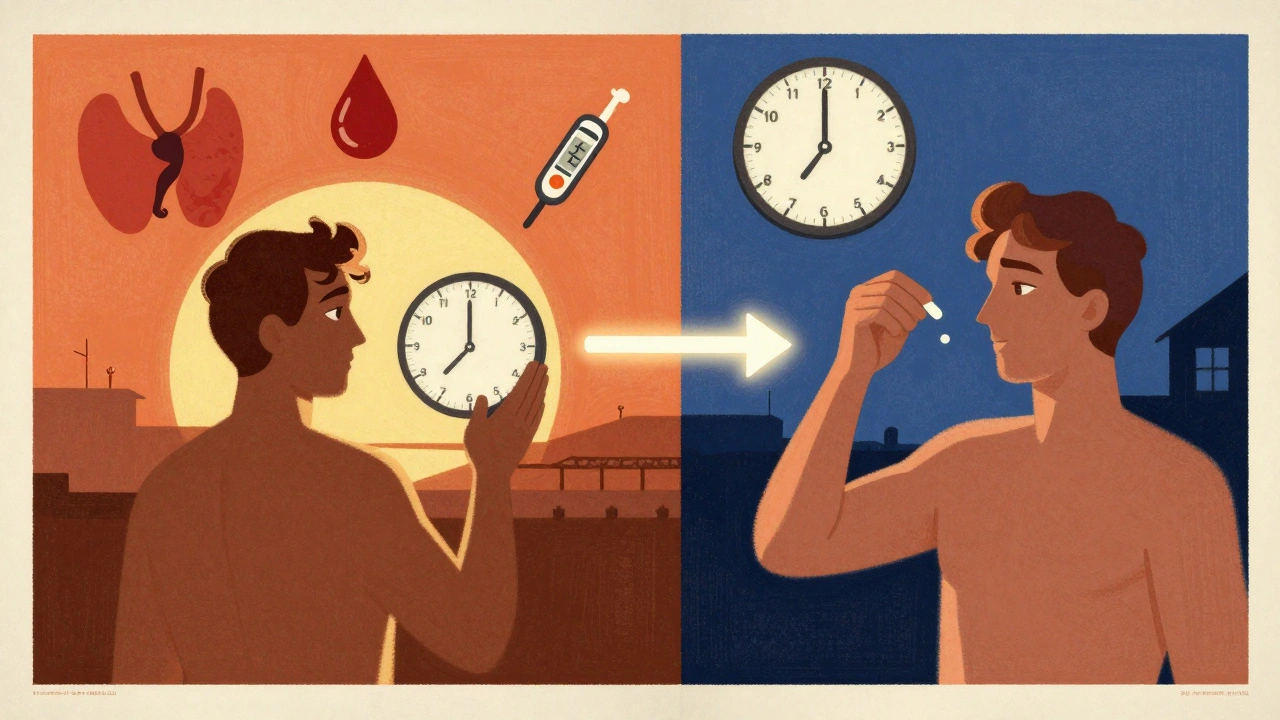
The solution is simple: separate your fiber from your meds. The standard advice from the Mayo Clinic, Cleveland Clinic, and the FDA is to take fiber supplements at least 1 hour before or 2 to 4 hours after any medication.Why not just take them together and drink more water? Because it doesn’t help. The gel forms fast-within 15 to 30 minutes. Water doesn’t wash it away; it makes it thicker. The only way to avoid interference is time.
Here’s how to make it work in real life:
- If you take your meds in the morning (like levothyroxine on an empty stomach), take fiber at night-at least 4 hours after your last pill. But wait-more on that later.
- If you take meds at night, take fiber in the morning-1 hour before breakfast.
- If you take multiple meds throughout the day, pick one consistent window. For example: fiber at 7 a.m., meds at 8 a.m., fiber again at 7 p.m., and last meds at 9 p.m.
Consistency matters more than perfection. One patient on Reddit, @MedSavvyRN, shared how their patient’s TSH levels stayed high for months until they realized the fiber was taken with levothyroxine. After switching to a 4-hour gap, levels normalized in six weeks.
What About Taking Fiber Before Bed?
Some sources suggest taking fiber at night to avoid morning conflicts. But here’s the catch: it often backfires.Research from Hilma (2023) found that 68% of people who took fiber within two hours of bedtime experienced bloating, gas, or cramps that disrupted sleep. FreeRx Blog (2022) specifically warns against taking Metamucil before bed-calling it a common cause of nighttime stomach discomfort. The gel doesn’t just sit there; it ferments, producing gas. That’s why many users report waking up with a swollen belly or needing to use the bathroom multiple times.
So if you’re taking meds in the morning, don’t just grab fiber at 10 p.m. Wait until at least midnight, and even then, monitor how you feel. If you wake up feeling bloated, move it earlier. The goal is to avoid both medication issues and sleep disruption.
Special Cases: Bariatric Surgery, IBS, and Statins
Not everyone follows the same rules.After bariatric surgery: Your stomach is smaller, your gut moves faster. Taking fiber too close to meds can cause blockages or poor absorption. Experts recommend waiting at least 1 hour before or 2-4 hours after meds, and starting with just 1-2 grams per day. Increase slowly.
With IBS: Soluble fiber like psyllium can help some, but worsen others. Bon Secours Blog (2022) found that 42% of IBS patients had worse symptoms when taking fiber on an empty stomach. If you have IBS, try taking fiber with a meal instead of before or after. Start low. Monitor.
With statins: This is the exception that proves the rule. A 2015 study in PMC showed that combining low-dose simvastatin with psyllium (taken before meals) actually lowered LDL cholesterol more than the statin alone. The fiber helped trap cholesterol in the gut, boosting the drug’s effect. So here, timing isn’t about avoidance-it’s about synergy. But this only works with specific doses and types. Don’t assume it applies to your meds. Ask your doctor.

How to Make This Stick
Knowing the rules isn’t enough. You need a system.- Make a chart: List all your meds and supplements with times. Mark where fiber fits in. Use a free app like Medisafe or a printed sheet taped to your fridge.
- Use phone reminders: Set two alarms: one for meds, one for fiber. Label them clearly: “Levothyroxine” and “Fiber-4 hours after.”
- Start low, go slow: Don’t jump to 10 grams of fiber overnight. Begin with 1-2 grams per day and increase by 1 gram every 3-4 days. This cuts down on gas and bloating.
- Drink water: Take each fiber dose with at least 8 ounces of water. Daily total should be 64-80 ounces. Fiber without water causes constipation.
- Check your labs: If you’re on thyroid meds, warfarin, or diabetes drugs, ask your doctor to check your levels 4-6 weeks after changing your fiber timing. Don’t wait for symptoms.
Why So Many People Get This Wrong
A 2022 survey by the National Community Pharmacists Association found that only 38.7% of patients received any timing advice from their pharmacist when buying fiber supplements. Most assume it’s just a “natural” health product-harmless. But fiber isn’t like vitamin C. It physically changes how your body handles drugs.Amazon reviews tell the story. Out of over 1,200 reviews for Metamucil, 37% of negative ones mention medication problems. Common complaints: “My blood pressure meds stopped working,” “My thyroid dose had to be doubled,” “I felt like I was having a heart attack-turns out my INR was too high.”
These aren’t rare cases. They’re predictable. And they’re preventable.
What’s Next?
Scientists are working on new fiber formulas that release slowly, reducing gel formation during medication absorption windows. Phase 2 trials are underway for time-release versions. But for now, the old rule still holds: separate your fiber and your pills.If you’re taking fiber and any prescription medication, don’t guess. Don’t assume it’s fine. Check with your pharmacist or doctor. Bring your supplement bottle. Ask: “Could this interfere with my meds?”
It’s not about avoiding fiber. It’s about using it safely. And that starts with timing.
Can I take fiber and vitamins at the same time?
It’s safer to separate fiber from vitamins, especially if they contain minerals like iron, calcium, or zinc. Fiber can bind to these minerals and reduce absorption. Take vitamins at least 2 hours before or after your fiber supplement. For multivitamins with fat-soluble vitamins (A, D, E, K), fiber has less impact-but still, separation is best practice.
Does all fiber cause the same interaction?
No. Soluble fibers like psyllium, guar gum, and inulin form thick gels and are the biggest offenders. Insoluble fibers like wheat bran or cellulose don’t gel as much, so they’re less likely to interfere. But even insoluble fiber can slow absorption slightly. For safety, assume all fiber supplements need separation from meds unless your doctor says otherwise.
What if I forget and take fiber with my pill?
If it happens once, don’t panic. One mistake won’t ruin your treatment. But don’t make it a habit. If you realize you took them together, wait at least 4 hours before taking your next dose of the medication. Monitor for symptoms-like unexplained fatigue (thyroid), dizziness (blood pressure), or unusual bruising (warfarin). Talk to your doctor if this happens repeatedly.
Can I switch to a different fiber supplement to avoid interactions?
Switching brands won’t help if the active ingredient is the same. Metamucil, Konsyl, and generic psyllium all contain the same fiber and act the same way in your gut. If you’re using psyllium and it’s interfering with your meds, you’ll face the same issue with any psyllium product. Consider switching to a non-gelling fiber like wheat bran-but only after talking to your doctor. Some people tolerate it better, but it doesn’t help cholesterol or blood sugar like soluble fiber does.
Do fiber gummies or chewables have the same risks?
Yes. Even if they’re gummies or chewables, if they contain psyllium, inulin, or other soluble fibers, they still form gel in your digestive tract. The form doesn’t change the mechanism. A chewable with 5 grams of psyllium will interfere with your meds just like a powder. Always check the ingredient list-not the packaging claims.




12 Comments
Jean Claude de La Ronde-11 December 2025
so fiber is just nature's little pill-wrapping gremlin huh? i took metformin with psyllium for a month and thought my diabetes was getting worse... turns out my gut was just hoarding my meds like a dragon with gold. who knew the fiber aisle was a pharmaceutical crime scene?
Jim Irish-12 December 2025
This is critical information that should be standard on every supplement label. Many patients assume 'natural' means 'safe with everything.' It does not. Pharmacists and physicians must prioritize clear communication on this issue.
Mia Kingsley-13 December 2025
OMG I KNEW IT. I took Metamucil with my levothyroxine for 8 months and my doctor kept upping my dose. I was crying in the bathroom from fatigue. Then I read this and switched to fiber at night. My TSH dropped 3 points in 3 weeks. I’m basically a medical genius now. 🙃
Aidan Stacey-13 December 2025
I work in a clinic and this is the #1 thing we miss. Patients come in with all these weird symptoms and we run every test under the sun. Then someone asks, 'Do you take fiber?' And boom - lightbulb. I wish every pharmacy had a little sticker on fiber bottles: 'DO NOT TAKE WITH MEDS.' Simple. Clear. Life-saving.
Courtney Blake-15 December 2025
I don't trust these 'studies.' America is obsessed with turning everything into a medical emergency. My grandma took fiber with her pills for 40 years and lived to 94. You're just selling fear. And also, who has time to wait 4 hours between pills and fiber? I have a job. I'm not a lab rat.
Lisa Stringfellow-15 December 2025
So basically, if you're poor and on meds, you're supposed to become a pharmacist just to take a supplement? And you're telling me to set alarms? That's not healthcare, that's a productivity hack for people who have no life. I'm not doing this.
Kristi Pope-16 December 2025
This is the kind of post that makes me feel less alone in this weird, messy world of trying to stay healthy without turning into a robot. I used to take fiber with my meds because I was lazy. Now I set a little sticky note on my fridge: 'Fiber after dinner, meds at breakfast.' It’s not perfect, but it’s mine. And my INR’s finally stable. Thank you for writing this with heart.
Aman deep-17 December 2025
In India we use isabgol (psyllium) daily. My aunt took it with her BP meds for years. One day she fainted. Doctor said her meds were barely absorbed. Now she takes it at 10pm, meds at 7am. No more dizzy spells. But no one told her. This needs to be shouted from rooftops - especially in places where pharmacy counseling is a luxury.
Eddie Bennett-17 December 2025
I used to take fiber at night because I thought it’d help me sleep. Instead I woke up looking like I swallowed a balloon. Then I realized I was also taking my statin before bed. I moved the fiber to morning, now I feel like a new person. Also - gummies? Same deal. Don’t be fooled by the flavor.
Sylvia Frenzel-18 December 2025
This article is ridiculous. Fiber is natural. Pills are synthetic. The body knows how to handle both. If your meds are being blocked by fiber, maybe you're on the wrong meds. Or maybe you're just overreacting to marketing.
Paul Dixon-19 December 2025
I took fiber with my thyroid med for 6 months and thought I was just getting old. Then I read this and switched the timing. My energy came back in 2 weeks. I didn’t even know I was tired until I wasn’t anymore. Small change. Huge difference.
Vivian Amadi-21 December 2025
You forgot to mention that fiber also messes with antidepressants. My SSRIs stopped working when I started Metamucil. My therapist thought I was lying about my mood. Turns out my gut was stealing my meds. This is a public health crisis.