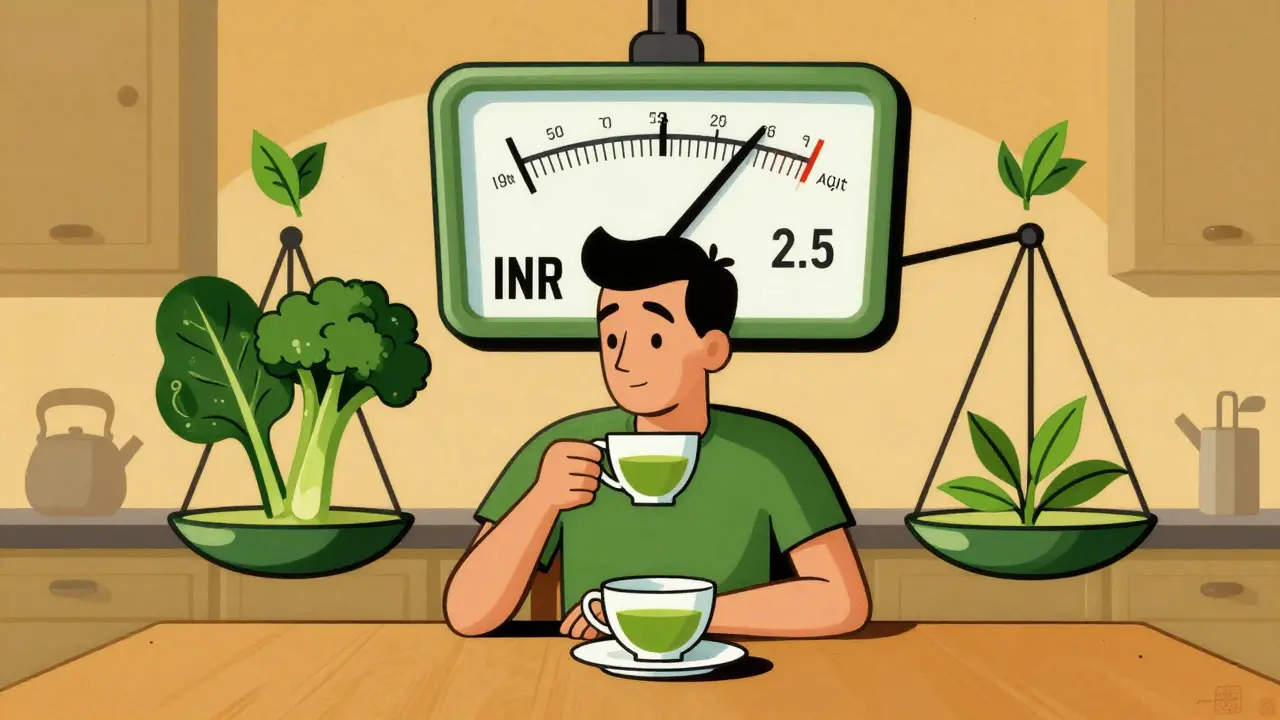
Green Tea and Warfarin Intake Calculator
Green Tea Intake
Matcha Intake
Results
If you're taking warfarin to prevent dangerous blood clots, your doctor likely told you to watch your diet. But what about green tea? It’s healthy, refreshing, and full of antioxidants - so why would it matter? The truth is, green tea can quietly mess with your INR levels, and that’s not something to ignore.
How Warfarin Works - And Why Vitamin K Matters
Warfarin (sold as Coumadin or Jantoven) keeps your blood from clotting too easily. It does this by blocking vitamin K, which your body needs to make clotting proteins. Without enough vitamin K, your blood takes longer to clot - and that’s exactly what you want if you have atrial fibrillation, a mechanical heart valve, or a history of deep vein thrombosis.
Your doctor checks your blood regularly with an INR test. That number tells them if your blood is clotting at the right speed. For most people, the target range is between 2.0 and 3.5. Go too low? You’re at risk for clots. Go too high? You could bleed internally. Either way, it’s dangerous.
Now here’s the catch: vitamin K directly fights warfarin’s effect. Eat more vitamin K, and your INR drops. Eat less, and your INR rises. That’s why consistency matters more than restriction. You don’t need to cut out vitamin K - you just need to keep your intake steady.
Green Tea Has Vitamin K - But Not as Much as You Think
Green tea comes from the Camellia sinensis plant. The leaves themselves are packed with vitamin K - about 1,428 micrograms per 100 grams. But here’s what most people don’t realize: you’re not eating the leaves. You’re drinking water that’s been steeped in them.
Brewed green tea contains only about 0.03 micrograms of vitamin K per 100 grams. That’s tiny. A standard 8-ounce cup (240 mL) has less than 0.1 microgram. Compare that to spinach (483 mcg per 100g) or broccoli (141 mcg per 100g). You’d need to drink over 1,000 cups of brewed green tea to match the vitamin K in one serving of kale.
So why do people have problems with green tea and warfarin? Because some people aren’t drinking tea - they’re drinking gallons of it.
The Real Problem: Excessive Consumption
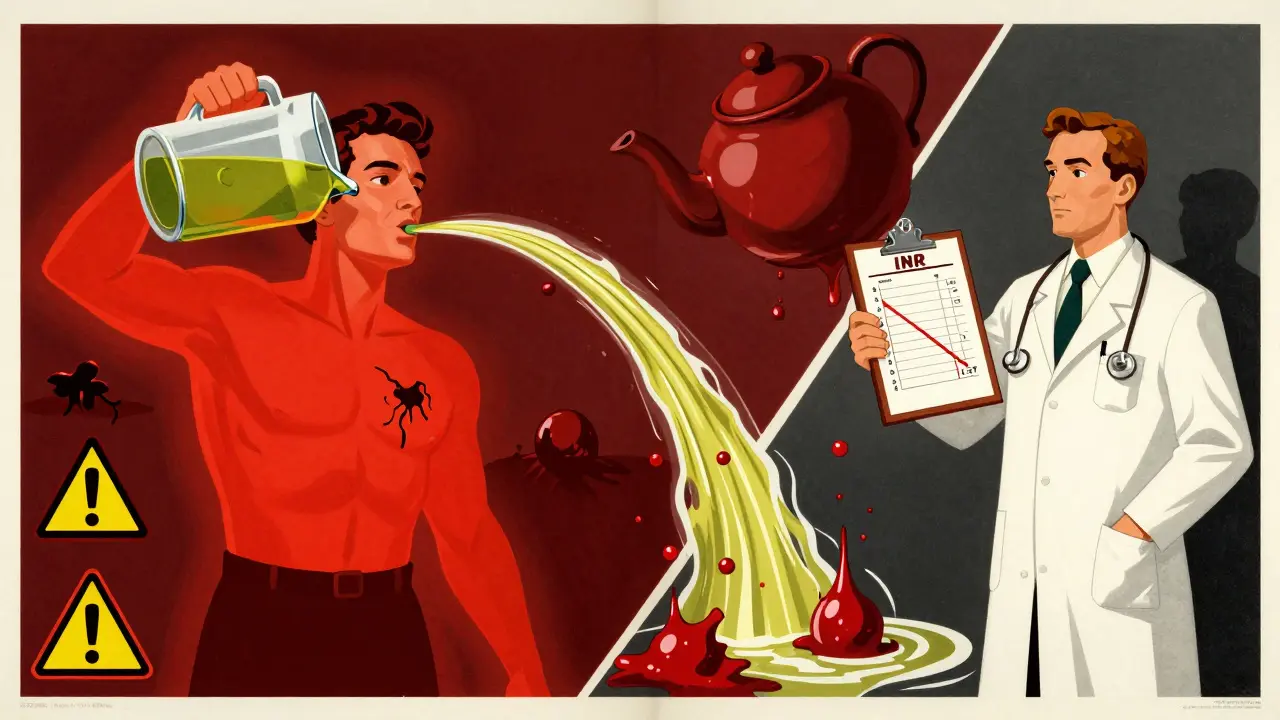
Case reports show that when people drink more than a gallon (3.8 liters) of green tea daily, their INR can crash. One well-documented case involved a 44-year-old man whose INR dropped from 3.79 to 1.37 after drinking 0.5 to 1 gallon of green tea every day. He was on 7.5 mg of warfarin. His blood was clotting too fast - and he almost had a stroke.
That’s not normal. Most people drink 1 to 3 cups a day. For those people, research from the American Heart Association and Mayo Clinic says there’s no need to worry. The 2023 guidelines from the American College of Chest Physicians agree: moderate green tea intake doesn’t require dose changes.
But moderation is key. What counts as moderate? One cup is 8 ounces. Three cups is 24 ounces - about 720 mL. That’s the upper limit most experts say is safe. Anything beyond that, especially if it’s daily, should raise a red flag.
Matcha Is a Different Story
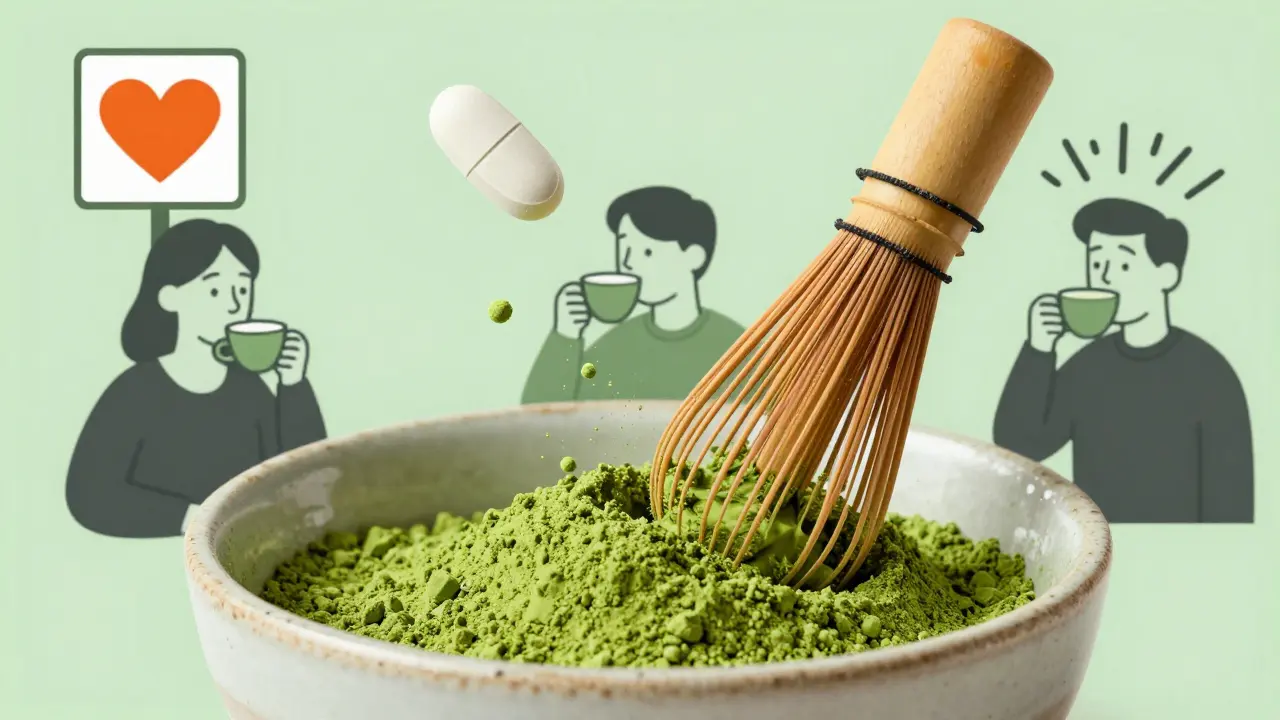
If you’re drinking matcha, you’re not just drinking tea - you’re consuming the whole ground leaf. That means you’re getting all the vitamin K that’s in the plant, not just what leaches into the water.
Matcha has 10 to 20 times more vitamin K than regular brewed green tea. A single teaspoon of matcha powder can contain over 1 microgram of vitamin K. That’s 10 times more than a cup of regular green tea.
Dr. John Smith from Mayo Clinic says he’s seen INR fluctuations in 15% of patients who regularly take matcha. One patient on r/Warfarin reported her INR dropped from 2.8 to 1.9 after drinking four cups of matcha daily for two weeks. Her warfarin dose had to be increased by 15%.
Matcha isn’t just a trendy latte. It’s a concentrated source of vitamin K. If you’re on warfarin and love matcha, you need to be extra careful.
It’s Not Just Vitamin K - There’s a Paradox
Here’s where it gets complicated. Green tea isn’t just about vitamin K. It also contains catechins - plant compounds that can actually thin the blood by inhibiting platelet clumping. Some studies suggest these compounds might enhance warfarin’s effect, not weaken it.
This creates a paradox: green tea could both increase and decrease bleeding risk. That’s why the interaction isn’t always predictable. One person might drink 4 cups a day and have no change in INR. Another might drink 2 cups and see a drop.
That’s why consistency is everything. Switching from 1 cup to 5 cups, or stopping green tea cold turkey, can cause your INR to swing wildly. The biggest danger isn’t drinking green tea - it’s changing how much you drink.
What About Other Teas and Herbal Products?
Green tea isn’t the only herbal product that interacts with warfarin. Ginkgo biloba, goji berry tea, and even cranberry juice can affect your blood thinning.
Cranberry juice is different - it blocks how your liver breaks down warfarin, making it stronger. That’s why it consistently raises INR. Green tea doesn’t work that way. Its effect is mostly about vitamin K, and only at high doses.
Black tea, which is also made from Camellia sinensis, has a similar profile. One case report showed a woman’s INR jumped from 1.7 to 5.0 after she stopped drinking black tea daily. Her body had adjusted to the vitamin K in the tea - when she quit, warfarin became too strong.
So if you’re switching from black tea to green tea, or vice versa, don’t assume it’s harmless. Track your intake and your INR.
What Should You Do?
Here’s the practical advice - no guesswork:
- If you drink 1 to 3 cups (8-24 oz) of regular green tea daily, keep doing it. No need to change anything.
- If you drink more than 3 cups daily, talk to your doctor. You may need more frequent INR checks.
- If you drink matcha, treat it like a supplement - not a beverage. Limit it to 1 teaspoon per day, and tell your anticoagulation team.
- Never suddenly stop drinking green tea if you’ve been having it daily. That can cause your INR to spike.
- Keep a simple log: how much green tea you drink each day. Bring it to your next INR appointment.
The American Heart Association says it best: “Maintain consistent vitamin K intake.” That means steady habits, not perfection. You don’t have to quit green tea - you just have to be predictable.
What If You’re Confused?
You’re not alone. A 2022 survey found that 62% of warfarin users didn’t know green tea could affect their INR until they had a problem. Another 38% avoided green tea entirely, even though they could have safely enjoyed it.
Most people don’t need to avoid green tea. They just need to know how much is too much. The difference between safety and risk is often just a few extra cups.
Pharmacists at PeaceHealth report that 42% of warfarin-related dietary questions in 2022 were about green tea. But in 80% of those cases, the solution was simple: keep your intake the same.
What’s New in 2025?
New research is making this easier. Apps like WarfarinWise now let you log your green tea intake and get alerts if you hit over 500 mL in a day. In a 2023 pilot study, users who used the app had 22% fewer INR fluctuations.
Also, the American Society of Hematology’s 2024 draft guidelines now define clear thresholds:
- ≤720 mL/day: no dose change needed
- 721-1,500 mL/day: check INR every two weeks
- >1,500 mL/day: increase warfarin dose by 10-15%
These aren’t official yet - but they’re becoming the new standard.
And while researchers are working on low-vitamin-K tea plants, that’s still years away. For now, the best tool you have is awareness - and consistency.


10 Comments
Nina Stacey-20 December 2025
i’ve been drinking green tea every morning for years since my pacemaker got installed and never thought twice about it until my last INR came back weird low
my doc just said keep doing what you’re doing and don’t suddenly quit or go nuts with matcha
so i just stick to 2 cups a day and don’t stress about it anymore honestly i think people overthink this stuff too much
Kevin Motta Top-20 December 2025
Matcha is the real culprit. Regular green tea? Fine. Matcha? Treat it like a vitamin K supplement.
Janelle Moore-20 December 2025
you know what they dont tell you? the FDA knows green tea is a stealth blood thinner and they let it slide because Big Pharma wants you hooked on warfarin
they dont want you drinking tea that fixes your clotting naturally
and matcha? that’s just the tip of the iceberg
they’re hiding the truth in plain sight and your doctor is paid to look the other way
Henry Marcus-21 December 2025
Okay, so let me get this straight: you’re telling me that a plant-based beverage-steeped from a leaf humans have consumed for 2,000 years-is suddenly a “dangerous variable” in a synthetic anticoagulant regimen? And the solution is… to track it like a drug? I mean, really?
Also, if matcha is 10x more potent, why is it sold in Whole Foods next to kale chips and artisanal kombucha like it’s harmless? This feels like a corporate smear campaign disguised as medical advice.
And don’t even get me started on how cranberry juice is “worse” but nobody screams about it. Why? Because it’s juice. Tea? It’s “herbal.” And herbal = suspicious.
Someone’s making money off this fear. I just don’t know who.
Isabel Rábago-22 December 2025
people are so careless these days
you take a life-saving drug and then you treat your diet like a buffet
if you can’t be consistent with your tea intake then maybe you shouldn’t be on warfarin at all
it’s not hard to count cups
it’s not hard to log it
but nooooo, you want to drink 10 cups of matcha and then blame your doctor when you bleed out
it’s not rocket science
just be responsible
Matt Davies-22 December 2025
My nan’s been on warfarin since 2012 and drinks 3 cups of green tea a day like clockwork-never had a hiccup. She also eats a ton of spinach, broccoli, and kale. Consistency, not fear, is the magic word.
Also, matcha lattes? Nah. That’s just sugar and anxiety in a cup.
Mike Rengifo-23 December 2025
so i’ve been drinking matcha every morning for a year and my INR’s been steady at 2.5
my pharmacist said if it ain’t broke don’t fix it
but i started keeping a little notebook just in case
also i switched from green to matcha last year and no drama
so maybe the rules are more like guidelines?
Dev Sawner-23 December 2025
It is imperative to underscore that the pharmacokinetic interaction between catechins and cytochrome P450 enzymes may potentiate the anticoagulant effect of warfarin independently of vitamin K modulation. The current literature remains inconclusive regarding dose-response thresholds, and anecdotal evidence from laypersons should not supplant clinical guidelines. One must exercise rigorous dietary documentation and maintain biweekly INR monitoring when introducing or altering any phytochemical intake. Failure to adhere to these protocols constitutes a significant clinical risk.
Moses Odumbe-24 December 2025
matcha = vitamin K bomb 🚨
green tea = chill vibes 🍵
consistency = your new best friend 😎
don’t be that guy who drinks a gallon and then cries when he gets a blood clot 🤦♂️
Meenakshi Jaiswal-24 December 2025
Hi everyone - I’m a pharmacist who works with anticoagulant patients daily. The most common mistake? People think they have to quit green tea entirely. You don’t.
What you need is to pick a daily amount - 1 to 3 cups of brewed tea - and stick to it. No spikes, no drops.
Matcha? One teaspoon per day max. Write it down. Bring it to your INR visit.
And if you’ve been drinking 5 cups a day for years? Don’t quit cold turkey. Cut back slowly - over a week - and get your INR checked after the change.
You’ve got this. Small, steady habits beat perfection every time.