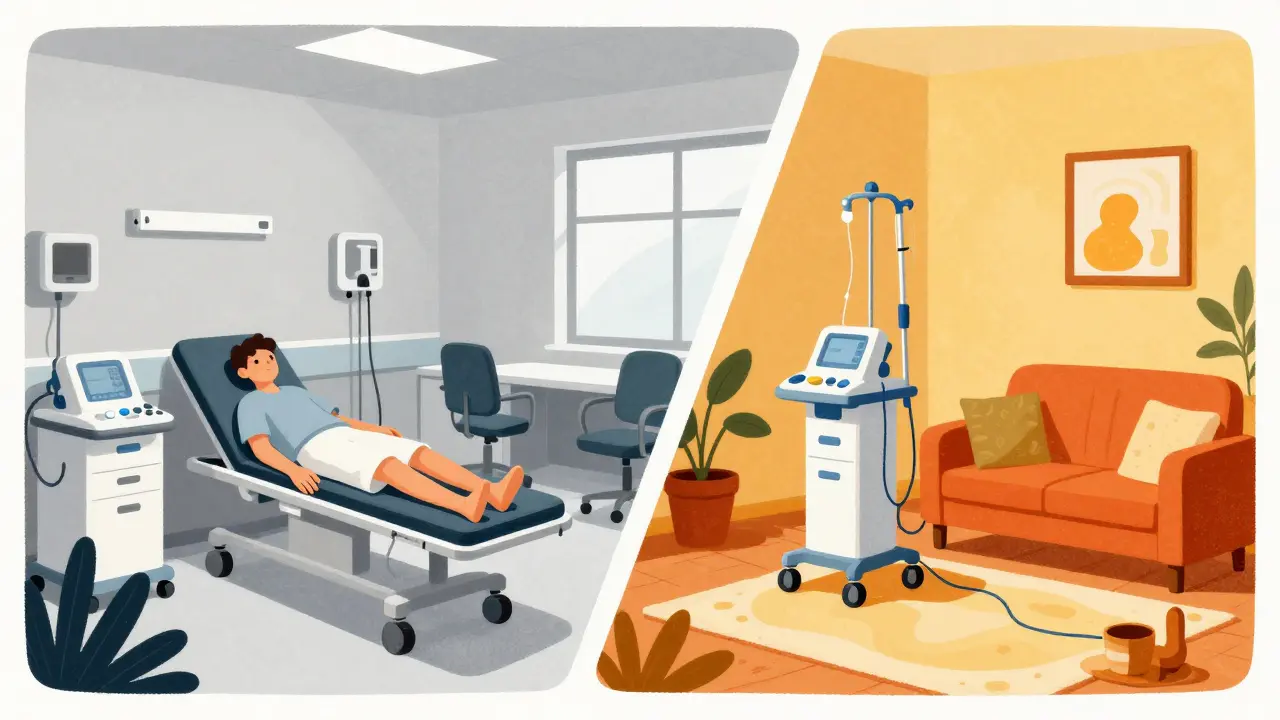
Choosing Your Treatment Rhythm
Not all home dialysis looks the same. Depending on your health needs and lifestyle, you'll likely fall into one of three scheduling patterns. The frequency and duration of these sessions directly impact how you feel and how your body handles toxins.- Conventional Home Hemodialysis: This is the closest mirror to clinic care. You typically go through three treatments per week, each lasting three to four hours. The big win here is the timing; you don't have to fight traffic at 6 AM to make a clinic appointment.
- Short Daily Home Hemodialysis: This involves more frequent, shorter sessions-usually five to seven times a week for two to three hours each. Because the blood is cleaned more often, it's easier on the heart. Research indicates this approach leads to better blood pressure control and a reduction in left ventricular mass.
- Nocturnal Home Hemodialysis: This happens while you sleep, often three to seven nights a week, with sessions lasting six to ten hours. This is the "gold standard" for toxin removal. Because the process is so slow and steady, it clears phosphorus and middle molecules far more effectively than shorter sessions.
| Schedule Type | Frequency | Duration per Session | Primary Clinical Benefit |
|---|---|---|---|
| Conventional | 3x per week | 3-4 hours | Maximum scheduling flexibility |
| Short Daily | 5-7x per week | 2-3 hours | Better BP control & heart health |
| Nocturnal | 3-7x per week | 6-10 hours | Superior phosphorus clearance |
The Road to Independence: Training and Certification
You can't just buy a machine and start. To ensure safety, patients and their care partners must undergo a structured training program. The length of this period varies. Some programs, like those at the University of Washington Medical Center , use virtual reality simulators to cut training down to 3-4 weeks. Other programs, including those following Maryland Department of Health guidelines, may take 8-12 weeks. Training isn't just about pushing buttons. You'll be tested on a variety of critical skills. You have to prove you can handle the "scary stuff"-like self-cannulation (inserting your own needles)-before you're cleared for home use. In fact, about 45% of trainees find needling the hardest part of the process. Beyond the needles, your training checklist includes:- Environment Setup: Organizing a 6x6 foot space that meets electrical and plumbing codes.
- Fluid Math: Calculating exactly how much fluid to remove during a session to avoid crashes.
- Machine Maintenance: Running disinfection cycles and monitoring reverse osmosis (RO) logs.
- Emergency Response: Recognizing low blood pressure and knowing how to react instantly.
- Supply Logistics: Ordering and storing the massive amount of dialysate and tubing required.
The Non-Negotiable: The Care Partner
Here is the part that surprises many: in most standard programs, you cannot dialyze alone. The safety risk is too high. If you faint or have a machine failure, you need someone there to intervene. This means your spouse, adult child, or close friend must undergo the same training you do. They aren't just "helpers"; they are certified operators. They must be able to set up the machine, insert needles, and manage complications. This requirement is a major hurdle-roughly 30% of potential candidates are disqualified simply because they don't have a reliable partner. While some portable systems like the NxStage System One offer paths to solo dialysis, it requires additional ancillary devices and specialized training that isn't the norm.Home Setup and Technical Requirements
Your home needs to be modified to accommodate the equipment. This isn't as simple as plugging in a toaster. You'll typically need a dedicated 120-volt, 20-amp electrical circuit to prevent the machine from tripping your breakers. Plumbing is the other big challenge. You'll need a dedicated drain line and a water supply line that maintains a pressure between 40 and 80 psi. Water quality is strictly monitored; you'll be keeping logs of chlorine and chloramine levels to ensure the water entering your blood is pure. If you plan to travel, you'll need to check if your machine is portable or if you'll need to coordinate with clinics at your destination.
Do the Outcomes Actually Improve?
Is all this effort worth it? The data suggests yes. When we look at End-Stage Renal Disease (ESRD) outcomes, home patients often fare better than those in clinics. A 2019 review in the American Journal of Kidney Diseases showed that home patients had 37% higher quality-of-life scores. Clinical survival is also a key metric. The United States Renal Data System (USRDS) has reported a 15-20% lower mortality rate for home hemodialysis patients compared to those in centers. The most striking gains come from frequency. For example, patients using nocturnal schedules have been found to have 42% lower serum phosphate levels, which means they can take significantly fewer phosphate-binding tablets daily. However, the trade-off is psychological. While users save an average of 10 hours a week in travel, many report initial anxiety about emergencies and occasional relationship strain with their care partners due to the intensity of the shared responsibility.How long does it actually take to feel comfortable with home dialysis?
Most patients require 20 to 30 supervised treatments before they feel fully confident. While the formal training might end in a few weeks, the "muscle memory" for things like self-needling and troubleshooting alarms usually takes a couple of months of consistent practice.
Can I do home hemodialysis if I live alone?
Standard programs generally require a trained care partner to be present during every treatment for safety. However, some advanced portable systems and specific clinic protocols allow for solo dialysis if the patient meets very strict psychological and physical criteria and uses specific safety monitoring equipment.
What are the most common complaints from home users?
The most frequent frustrations include the noise and frequency of machine alarms, the burden of managing and storing bulky supplies, and the emotional toll of depending on a care partner.
Does home dialysis improve my diet?
Yes, particularly with more frequent or nocturnal schedules. Because toxins and phosphorus are removed more consistently, patients often find they have more flexibility with their diet and a reduced need for medications like phosphate binders.
Is the equipment expensive?
For most patients in the U.S., Medicare covers the cost of the machine and supplies. Reimbursement policies have expanded significantly since 2011 to encourage more patients to transition from center-based care to home-based care.



1 Comments
Robin Walton-10 April 2026
This is such a helpful breakdown for anyone feeling overwhelmed by the clinic routine. Transitioning to home care can be a huge mental leap but the quality of life gains are so worth it.