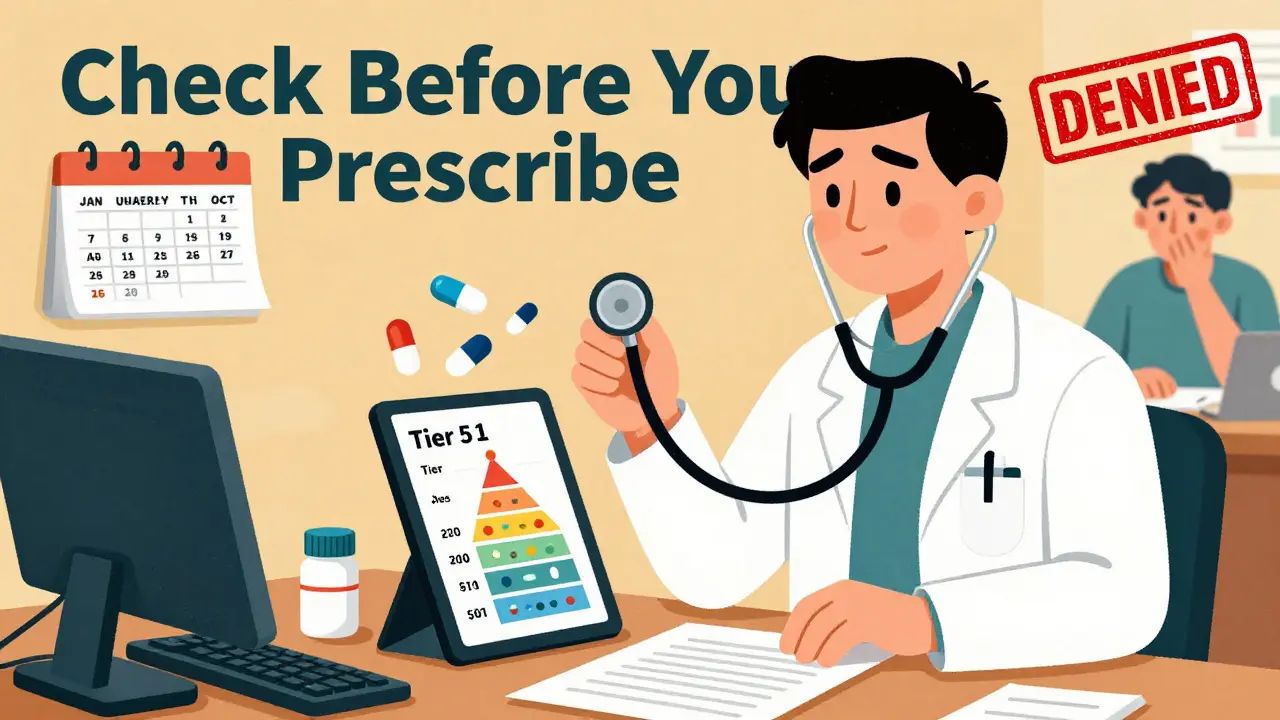
Every time you write a prescription, you’re not just choosing a drug-you’re choosing a cost. And if that cost isn’t covered, your patient might skip the medication, split pills, or skip refills entirely. That’s not hypothetical. In 2024, nearly 1 in 5 Medicare beneficiaries skipped a prescribed medication because of cost. The key to preventing this? Checking the formulary before you write the script.
What Exactly Is a Formulary?
A formulary, also called a Preferred Drug List (PDL), is the official list of medications covered by a patient’s insurance plan. It’s not a suggestion. It’s a contract between the insurer and the pharmacy benefit manager (PBM) that determines which drugs are available at what price. These lists are built by teams of doctors and pharmacists who review clinical data, real-world outcomes, and cost-effectiveness. Medicare Part D plans, for example, must cover at least two drugs in each therapeutic category and follow strict CMS rules. But commercial insurers like UnitedHealthcare or Aetna have more flexibility-and that means the same drug can be on Tier 1 at one plan and Tier 4 at another.Formularies aren’t static. They change. Medicare Part D plans must give 60 days’ notice before removing a drug or raising costs, but many insurers update monthly. HealthPartners, for instance, releases updates in January, April, July, and October. If you’re prescribing Januvia in December 2025, you can’t assume it’s still Tier 3 in every plan. One patient might have a plan where it’s preferred. Another might need prior authorization. A third might not be covered at all.
Understanding the Tier System
Most formularies use a tiered structure to control costs. The lower the tier, the less the patient pays. Here’s how it typically breaks down in Medicare Part D plans:- Tier 1: Preferred generics-often $1-$5 per prescription
- Tier 2: Non-preferred generics-$10-$20
- Tier 3: Preferred brand-name drugs-$40-$70
- Tier 4: Non-preferred brands-$80-$150+
- Tier 5: Specialty drugs-costs over $950/month, paid as a percentage (e.g., 33% coinsurance)
But here’s the catch: commercial plans often have four tiers, not five. Medicaid plans vary by state. Some states have closed formularies-meaning if a drug isn’t on the list, you need prior authorization just to request it. Others are open, giving you more leeway. Without knowing the plan, you’re guessing. And guessing costs patients money-and sometimes health.
How to Check a Formulary: 4 Reliable Methods
You don’t need to memorize every formulary. You need a system. Here are the four most effective ways to check coverage before prescribing:
- Use the insurer’s online drug search tool-Most major insurers (Aetna, UnitedHealthcare, Humana) have searchable databases on their provider portals. You enter the drug name, the patient’s plan name, and sometimes their county. These tools show the tier, any prior authorization (PA) or step therapy (ST) requirements, and quantity limits (QL). Aetna’s tool, for example, is rated "very helpful" by 74% of providers surveyed in 2024.
- Check your EHR system-If your clinic uses Epic, Cerner, or another modern system, you likely have a built-in formulary checker. Northwestern Medicine cut prescription abandonment by 42% after implementing Epic’s Formulary Check module in late 2023. It flags coverage issues in real time as you type the prescription.
- Call the plan’s provider line-98% of Medicare Part D plans offer 24/7 provider support lines. If you’re unsure about a drug’s status, call. Have the patient’s ID and plan name ready. Ask: "Is this drug covered? What tier? Are there PA, ST, or QL requirements?"
- Use CMS Plan Finder-For Medicare patients, the official Medicare Plan Finder tool covers 99.8% of Part D plans. You can search by drug name and zip code to see what’s covered under each plan. It’s not perfect, but it’s the most comprehensive public source.
Don’t rely on memory. Don’t assume your last patient’s plan matches this one. A 2023 Sermo survey found that primary care doctors spend an average of 18.7 minutes per patient just verifying coverage. That’s not wasted time-it’s preventative medicine.
What Those Abbreviations Mean: PA, ST, QL
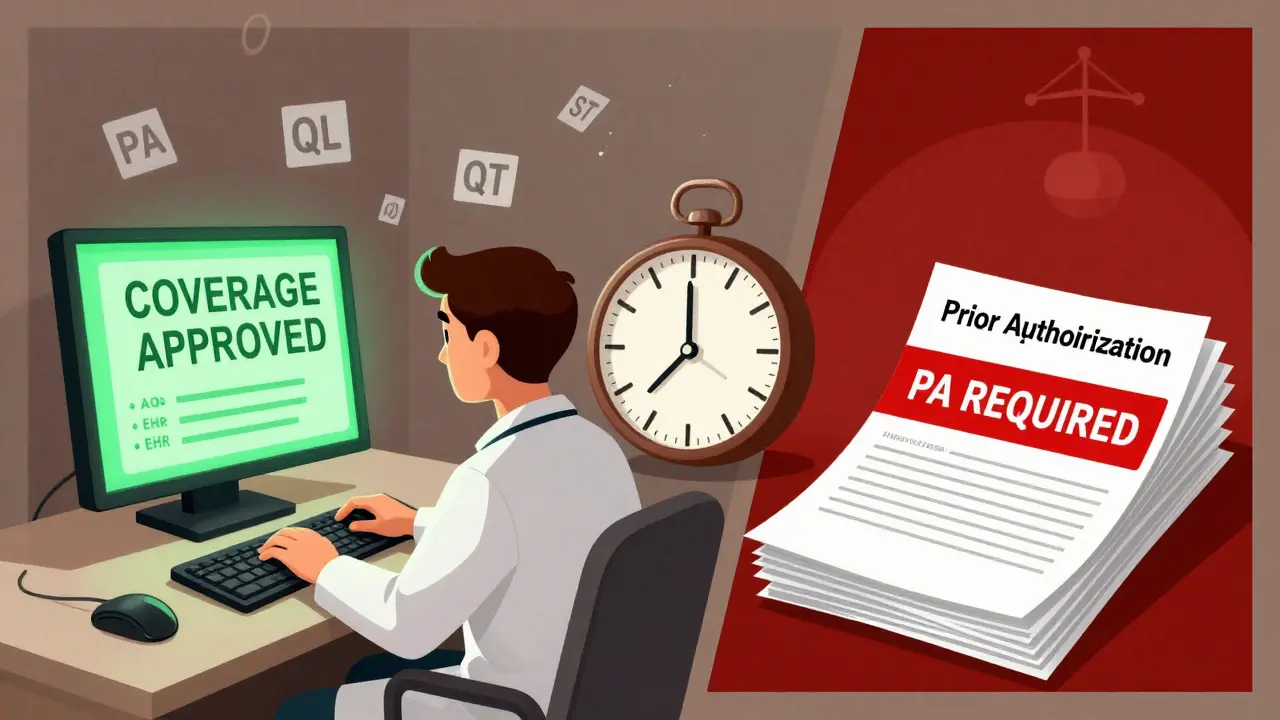
Formularies don’t just list drugs-they attach rules. You’ll see three common codes:
- PA (Prior Authorization): The insurer requires documentation before approving the drug. This often means submitting lab results, failed trial records, or a letter explaining why the preferred drug won’t work.
- ST (Step Therapy): The patient must try and fail on a cheaper, preferred drug first. For example, you might need to try metformin before prescribing semaglutide for type 2 diabetes.
- QL (Quantity Limit): The insurer caps how much you can prescribe at once. Example: Only 30 tablets of oxycodone per 30 days unless you request an exception.
These aren’t just bureaucracy. They’re designed to reduce unnecessary spending. But they can delay care. A 2024 AMA report found that 88% of physicians have seen treatment delays because of prior authorization. In cancer care, 32% of PA requests take longer than 48 hours to process. That’s not just frustrating-it’s dangerous.
Why Formularies Vary So Much
Not all insurance is the same. Medicare Part D plans follow federal rules. Medicaid plans are state-run, so a drug covered in California might be excluded in Texas. Commercial plans are shaped by market competition. UnitedHealthcare’s 2024 formulary has four tiers. Aetna’s has five. Some plans bundle specialty drugs into separate networks. Others require patients to use specific pharmacies.
And then there’s the issue of mid-year changes. CMS allows insurers to remove drugs or raise costs with 60 days’ notice. But many do it anyway-especially for high-cost specialty drugs. A December 2023 GAO report found that 28% of Medicare beneficiaries faced unexpected formulary changes mid-year. That means a drug covered in January might be gone by June. If you don’t check every time, you’re risking a patient’s adherence.
How to Build a Sustainable Workflow
Checking formularies shouldn’t be a last-minute scramble. Build it into your routine:
- Make it a habit: Dedicate 3-5 minutes per patient during medication selection. Use a checklist: drug name → plan → tier → PA/ST/QL → alternative if needed.
- Bookmark key pages: Save direct links to your most common insurers’ formulary search tools. For example: UnitedHealthcare’s 2024 Commercial Drug List, Aetna’s Medicare Drug List.
- Set calendar alerts: Mark quarterly update dates for HealthPartners, Humana, and other major plans. Set reminders for January 1 and July 1 each year-when most formularies refresh.
- Use alternatives wisely: If a drug is non-preferred or requires PA, have a Tier 1 or Tier 2 backup ready. Know your go-to generics. They’re not just cheaper-they’re more likely to be covered.
Small practices lag behind. Only 38% of small clinics have formal formulary checking protocols, compared to 79% of large health systems. But you don’t need a big IT budget. You just need a system.
What’s Changing in 2025 and Beyond
Big changes are coming. The Inflation Reduction Act caps Medicare Part D out-of-pocket costs at $2,000 per year starting January 1, 2025. That’s already pushing insurers to move more drugs to lower tiers. By 2025, 73% of Medicare formularies will have shifted drugs down to reduce patient burden.
By January 1, 2026, CMS requires all Medicare Part D plans to integrate real-time benefit tools (RTBT) directly into EHRs. That means, in the near future, your EHR will show coverage, cost, and PA status as you type the prescription-no separate logins needed. Epic’s FormularyAI, launched in August 2024, already predicts coverage likelihood with 87% accuracy by analyzing 10 million historical decisions.
But the biggest challenge remains: access. Even with better tech, prior authorization delays persist. And formularies still favor cost over clinical nuance. As Dr. Aaron Kesselheim warned in JAMA, overly restrictive lists can delay life-saving treatments. Your job isn’t just to follow the rules-it’s to advocate when they fail.
Final Thought: Coverage Is Part of Care
Prescribing isn’t just about diagnosis and dosing. It’s about access. A drug that’s perfect on paper means nothing if the patient can’t afford it-or can’t get it approved in time. Checking formularies isn’t administrative busywork. It’s clinical judgment. It’s preventing hospitalizations. It’s keeping patients on their meds.
Every time you skip the check, you’re gambling with someone’s health. Don’t gamble. Check. Every time.
What’s the difference between a formulary and a preferred drug list?
They’re the same thing. "Formulary" is the industry term used by insurers and PBMs. "Preferred Drug List" (PDL) is often used by Medicaid programs and government agencies. Both refer to the official list of medications covered under a health plan, with tiers and restrictions.
Can I prescribe a drug not on the formulary?
Yes-but the patient will likely pay much more, or the claim will be denied. For closed formularies (common in Medicaid), you must submit a prior authorization request explaining why the non-formulary drug is necessary. For open formularies, you can prescribe it, but the patient may face high out-of-pocket costs. Always check coverage first.
How often do formularies change?
Medicare Part D plans must notify patients 60 days before removing a drug or raising costs. Many insurers update quarterly-HealthPartners, for example, releases updates in January, April, July, and October. Commercial plans may update more frequently. Always verify coverage at the time of prescribing, not just once a year.
Why does the same drug have different tiers across plans?
Each insurer negotiates separate deals with drug manufacturers. One plan might get a better discount on a brand-name drug, so they put it in Tier 3. Another plan might not have that deal, so they place it in Tier 4. Tier placement depends on cost, rebates, and clinical preferences-not just the drug itself.
What should I do if a patient’s drug gets removed from the formulary?
First, check if there’s a therapeutic alternative on the formulary. If not, file a prior authorization request for the original drug, including clinical justification. You can also help the patient switch plans during open enrollment or request a special enrollment period if the change affects their health. Document everything-this is a coverage issue, not a clinical failure.
Are there tools that automatically check formularies?
Yes. EHR systems like Epic, Cerner, and Allscripts now integrate formulary checkers. Medicare Part D plans are required to offer real-time benefit tools (RTBT) by January 2026, which will show coverage and cost as you write the prescription. Some AI tools, like Epic’s FormularyAI, predict coverage likelihood with 87% accuracy based on historical data.


Write a comment