When you pick up a generic pill at the pharmacy, you’re getting the same active ingredient as the brand-name version-same chemistry, same dose, same intended effect. But here’s the thing: generic drugs don’t go through the same safety trials as brand-name drugs before they hit the market. That’s not an oversight. It’s by design. The FDA approves generics based on bioequivalence-proving they work the same way in the body. But that doesn’t mean they’re risk-free. What happens after approval? That’s where post-market studies and clinical follow-up come in.
Why Generic Drugs Need Extra Monitoring
Brand-name drugs spend years in clinical trials involving thousands of patients under controlled conditions. These trials look for side effects, interactions, and dosing issues. But for generics? The FDA allows approval based on a much smaller set of data. Usually, it’s just one or two small studies showing the generic matches the brand in how it’s absorbed and processed. That’s efficient. It keeps prices low. But it also means rare side effects, long-term risks, or issues in vulnerable groups-like older adults, pregnant women, or kids-might not show up until thousands or millions of people are taking it. That’s why the FDA and other global regulators treat generic drugs like a live experiment once they’re on the shelf. The goal isn’t to prove they’re safe before launch-it’s to catch problems after launch. And it’s not theoretical. In 2022, the FDA issued 1,247 recalls for generic drugs. That’s 78% of all drug recalls that year. Most weren’t about contamination. They were about performance: tablets that didn’t dissolve properly, patches that fell off, liquids that formed clumps.How Safety Is Tracked After Approval
The FDA doesn’t wait for complaints. It actively hunts for signals. One major system is MedWatch, where doctors, pharmacists, and patients can report adverse events. But the real power comes from the Sentinel Initiative, launched in 2008 and fully running by 2016. Sentinel connects to health records from over 300 million Americans. It scans for patterns: Are people taking a certain generic version of levothyroxine more likely to have heart palpitations? Are patients on a specific batch of metformin reporting more stomach issues? The system flags these automatically. Manufacturers are required to report serious side effects within 15 days. Non-serious ones go in periodic reports. But here’s the catch: most reports don’t say which generic brand was taken. Only 35% of adverse event reports in 2022 named the manufacturer. That makes it hard to know if the problem is with one company’s version-or if it’s a class-wide issue. A pharmacist in Texas told the FDA about three patients who developed irregular heartbeats after switching from one generic levothyroxine to another. Same drug. Different maker. Same dose. But the new version caused problems. That’s the kind of signal Sentinel is built to find.Complex Generics Are the Biggest Concern
Not all generics are created equal. Simple pills-like atorvastatin or amoxicillin-are low-risk. But complex products? Those are where things get messy. Think inhalers, injectables, topical creams, and drug-device combos like auto-injectors or transdermal patches. These require precise manufacturing. A tiny change in the inactive ingredients-or how the tablet is pressed-can change how the drug behaves in the body. In 2022, 40% of FDA’s targeted safety reviews focused on these complex generics. One example: transdermal patches for pain or hormones. If the adhesive doesn’t hold properly, the drug doesn’t get absorbed. Patients might think the medication isn’t working. In reality, it’s a quality issue. In MedWatch reports, 27% of patch-related complaints mention falling off or poor adhesion. Another issue: oral liquids that form precipitates. A generic version of a liquid antibiotic might look clear in the bottle, but once mixed, it turns cloudy. That means some patients get too much drug, others get too little.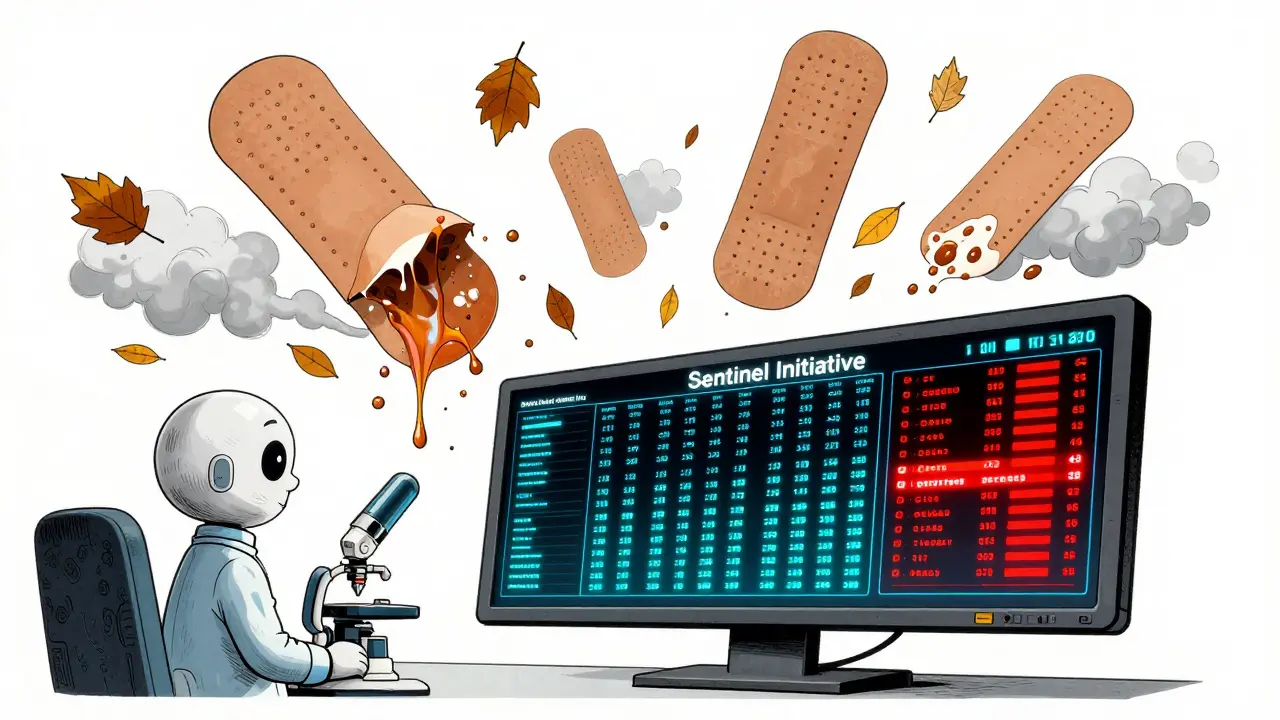
Who’s Responsible-and How Much Does It Cost?
Generic manufacturers must have full pharmacovigilance systems. That means staff, software, reporting protocols, and training. The median annual cost for a generic company to run this system? $1.2 million. For small manufacturers with only a few products, that’s a huge burden. Many still rely on manual reviews. The top 20 generic companies? 78% use AI tools to scan reports and spot patterns. Smaller ones? 85% don’t. That creates a gap. Big companies can catch problems early. Smaller ones might miss them until someone gets hurt. The FDA doesn’t just watch. It acts. In 2021, Teva received a warning letter for failing to report adverse events properly. Their new generic approvals were delayed for six months. That’s not a fine. That’s a business stop. The message is clear: safety isn’t optional.What Patients and Providers Are Seeing
Most patients switch to generics without issue. A 2023 Kaiser Family Foundation study found 89% of people on generics for high blood pressure or diabetes reported no problems. But for drugs with a narrow therapeutic index-where the difference between a helpful dose and a harmful one is small-things get tricky. Levothyroxine, warfarin, lithium, and some seizure meds fall into this category. A 2022 survey of 1,500 U.S. doctors found that 42% had seen patients react differently after switching between generic brands. Some reported new fatigue, tremors, or mood swings. Only 18% filed formal reports. Why? Because they’re not sure if it’s the drug-or the patient’s other medications, stress, or diet. But when multiple patients report the same issue after a switch, it’s a red flag. One pharmacist on Reddit shared a case: three patients developed palpitations after switching from one levothyroxine brand to another. All had stable thyroid levels before. After the switch, their TSH spiked. Dose adjustments were needed. That’s not coincidence. That’s a signal.
The Future: Better Tracking, Better Data
The FDA’s 2024-2026 plan calls for product-specific surveillance plans for high-risk generics. That means not just watching all levothyroxine-but watching each manufacturer’s version separately. They’re also rolling out the Sentinel Common Data Model Plus, which adds social factors like income, access to care, and diet into the safety analysis. Why? Because a patient who can’t afford food might miss doses. That’s not a drug issue. But it can look like one. Pilot programs are testing blockchain to track each batch of generic drugs from factory to pharmacy. If a problem pops up, they can trace it to one lot, one plant, one manufacturer. No more guessing. And the funding? The FDA’s GDUFA III plan, launched in 2023, includes $15 million specifically for generic drug safety. That’s a 27% increase in targeted reviews since 2019.What You Should Know
If you take a generic drug and feel different after a switch-even if it’s the same name-you’re not imagining it. Talk to your doctor. Ask: Did the manufacturer change? Keep the pill bottle. Note the name on the label. If you notice new side effects, report them to MedWatch. You don’t need to be a doctor. Your report could help prevent someone else’s harm. The system isn’t perfect. But it’s getting smarter. And it’s working. Without post-market studies, we’d never know that some generic patches fall off. That some tablets dissolve too slow. That a change in one inactive ingredient can cause heart rhythm problems in a small group of people. Generic drugs save billions. They make medicine accessible. But access doesn’t mean safety by default. It means vigilance. And that vigilance doesn’t stop when the pill leaves the factory. It continues every time someone swallows it.Are generic drugs less safe than brand-name drugs?
No, generic drugs are not inherently less safe. They must meet the same FDA standards for quality, strength, and purity as brand-name drugs. But because they’re approved without new clinical trials, rare or long-term side effects may not be known until after they’re widely used. That’s why post-market surveillance is critical-it catches problems that pre-approval studies miss.
Why do some people have different reactions to different generic versions of the same drug?
Generic drugs must contain the same active ingredient, but they can differ in inactive ingredients like fillers, dyes, or coatings. These can affect how quickly the drug dissolves or is absorbed. For drugs with a narrow therapeutic index-like levothyroxine or warfarin-small changes in absorption can lead to noticeable differences in how patients feel. That’s why switching between generic brands can sometimes cause side effects.
What should I do if I think my generic medication is causing side effects?
First, don’t stop taking the medication without talking to your doctor. Then, check the manufacturer name on the pill bottle. If you’ve recently switched brands, note that. Report your experience to your healthcare provider and file a report with the FDA’s MedWatch system. Even if you’re unsure, your report helps regulators spot patterns. You can submit reports online at fda.gov/medwatch.
Do all generic drug manufacturers have the same safety standards?
Yes, all manufacturers must follow the same FDA regulations for manufacturing and reporting. But resources vary. Large companies often use AI tools and real-time data systems to detect safety signals. Smaller companies may rely on manual reviews, which can delay detection. The FDA inspects all facilities, but the ability to respond quickly to emerging risks isn’t equal across the industry.
How often does the FDA take action against unsafe generics?
The FDA takes action regularly. In 2022, it issued 47 safety alerts specifically for generic drugs and conducted 328 targeted safety reviews. Actions include warning letters, product recalls, and delays in approving new generics. For example, Teva’s approval of new generic products was delayed for six months in 2021 due to inadequate adverse event reporting.
Can I trust my generic medication if it’s much cheaper than the brand?
Yes, cost doesn’t mean lower quality. Generic drugs are required to be bioequivalent to the brand. The lower price comes from reduced marketing and R&D costs-not lower standards. However, if you notice changes in how you feel after switching to a cheaper version, especially with critical medications, speak up. It’s not about price-it’s about consistency and monitoring.


13 Comments
Cassandra Collins-15 December 2025
soooooo... you're telling me the FDA just lets companies slap a label on a pill and call it 'safe'?? no wonder people are getting sick. i heard a guy on youtube who said the government is in cahoots with big pharma to keep us dependent on meds. my cousin took a generic thyroid pill and started having panic attacks. they said it was 'stress' lol. smh. #conspiracybutalsoreal
Elizabeth Bauman-16 December 2025
Let me be perfectly clear: America makes the safest, most rigorously tested medications in the world. The FDA doesn't cut corners-it enforces standards. Generic drugs are held to the exact same bioequivalence criteria as brand-name. The recalls you mention? Most are due to foreign manufacturing facilities with sketchy quality control. We need more inspections overseas, not less trust in our system. This isn't a failure-it's a feature of global supply chains.
Mike Smith-16 December 2025
Thank you for writing this with such clarity and care. The public needs to understand that safety doesn’t end at approval-it evolves with use. The Sentinel Initiative is one of the most underappreciated public health achievements of the last decade. It transforms passive reporting into proactive intelligence. To those who say, 'It’s just a pill,' remember: millions rely on these medications daily. Vigilance isn’t paranoia-it’s responsibility.
Ron Williams-17 December 2025
As someone who’s lived in four countries, I’ve seen how different systems handle generics. In India, they’re cheaper but sometimes inconsistent. In Germany, they’re tracked by serial numbers. Here in the U.S., we’ve got the tech but not always the transparency. The real issue? Patients don’t know which brand they’re getting. If pharmacies had to list the manufacturer on the receipt, people could track their own reactions. Small change. Big impact.
Andrew Sychev-17 December 2025
They’re lying. They always lie. You think this is about safety? It’s about control. The FDA, Big Pharma, the WHO-they all work for the same shadowy cabal that wants you dependent on pills. The 'inactive ingredients' they talk about? That’s the poison. They change the dye, the filler, the coating-whatever it takes to make you feel worse so you buy more. I’ve seen it. My sister’s heart rate spiked after switching generics. The doctors called it 'anxiety.' It was the pill. They don’t want you to know.
Hadi Santoso-18 December 2025
wait so if two generics have the same active ingredient but different fillers, and one makes me feel like a zombie and the other doesn't... that's actually legal? i switched from one levothyroxine to another and suddenly i couldn't get out of bed. my doctor said 'it's probably not the drug.' but i checked the bottle-different maker. now i only buy the one with the blue cap. i don't care what the science says. my body knows.
Arun ana-19 December 2025
From India, I can say generics are life-changing here. We don’t have access to expensive brands. But yes, sometimes the quality varies between manufacturers. One batch of metformin made my stomach upset-another didn’t. I started noting the manufacturer name on my phone. Now I stick to the ones that work. It’s not perfect, but it’s how we survive. I hope the FDA’s blockchain idea works-it’s the future.
Kayleigh Campbell-19 December 2025
So let me get this straight: we let companies sell pills that *might* dissolve in your stomach like wet cardboard, or leak hormones like a faulty garden hose… and we call that 'efficiency'? 🤡 The FDA’s got a 1.2 million dollar budget for safety, but Big Pharma’s marketing budget could buy a small island. I’m not mad-I’m just disappointed. And also, why does every generic pill look like a 90s computer game sprite?
Dave Alponvyr-19 December 2025
Switched generics. Got dizzy. Switched back. Dizziness gone. Done. No report needed. If it ain’t broke, don’t fix it. But if it breaks? Tell your doc. Simple.
Kim Hines-21 December 2025
I’ve been on the same generic for seven years. Never had an issue. But I read this article and now I’m staring at my pill bottle like it’s a time bomb. Maybe I’m overthinking it. Or maybe I’m finally paying attention. Either way, I’m keeping the label.
Joanna Ebizie-22 December 2025
Oh please. You think this is news? I work in a pharmacy. People come in every week asking why their new generic 'doesn’t work'-same dose, same name, different manufacturer. We’ve got a whole drawer of 'problem' generics we don’t even stock anymore. But the insurance company forces the switch. So we sit there while people cry because their anxiety meds turned them into zombies. This isn’t science. It’s corporate roulette.
James Rayner-22 December 2025
It’s heartbreaking, really. We expect our medications to be flawless, but we treat them like commodities-cheap, interchangeable, disposable. And yet, for someone with epilepsy or heart disease, that tiny difference in absorption could mean life or death. The system isn’t broken-it’s underfunded and overburdened. We need more funding, more transparency, and more empathy. Not just for patients… but for the pharmacists and doctors who are trying to hold it all together.
Souhardya Paul-24 December 2025
Really appreciate the breakdown on complex generics-especially patches and liquids. I never realized how much formulation matters. My mom’s diabetes patch kept falling off-she thought she was being 'lazy' about applying it. Turns out, it was the adhesive. Once we switched brands, she stopped getting random high readings. It’s wild how much we assume 'same drug = same effect.' We need better labeling, better education, and better tracking. This isn’t just a regulatory issue-it’s a patient empowerment issue.