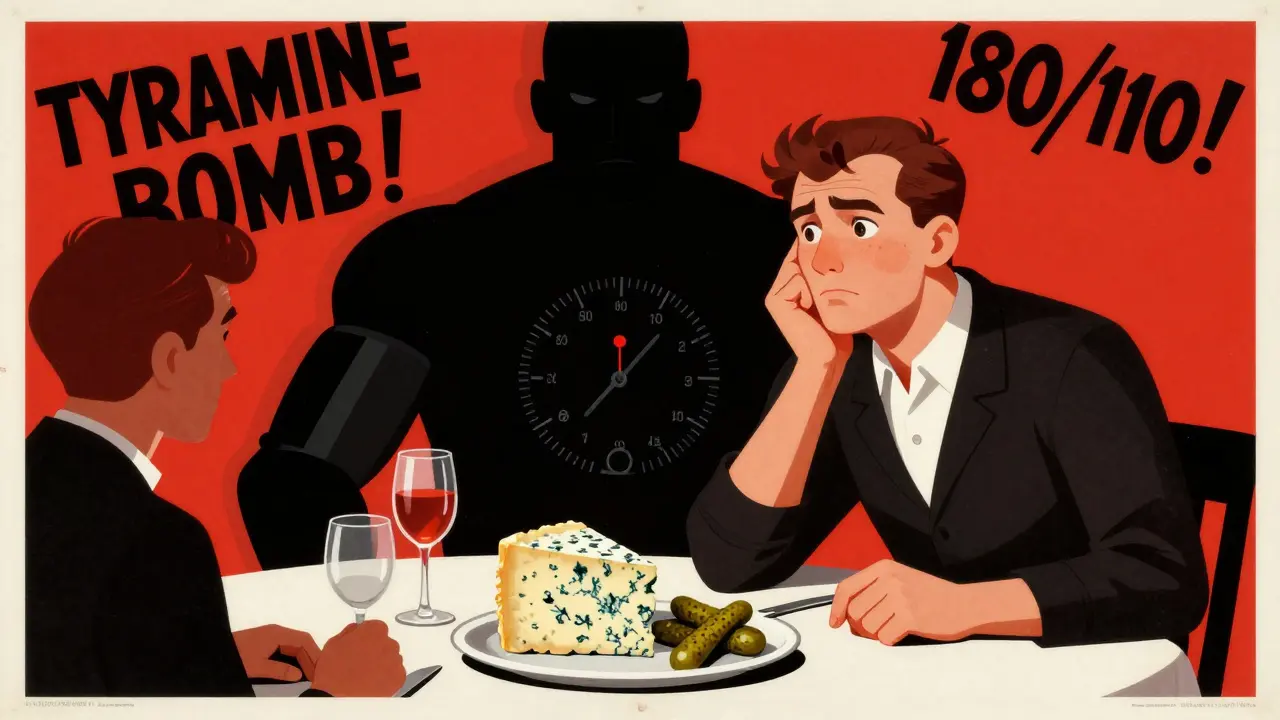
When you're taking an MAO inhibitor for depression, your diet isn't just about nutrition-it's a safety issue. One bite of the wrong cheese, a glass of aged wine, or even leftover leftovers could send your blood pressure soaring in minutes. This isn't a myth. It's a real, documented risk called a hypertensive crisis, and it can land you in the emergency room-or worse.
MAO inhibitors, or MAOIs, are powerful antidepressants used when other treatments fail. They work by blocking an enzyme called monoamine oxidase, which normally breaks down chemicals in your brain like serotonin and norepinephrine. But that same enzyme also handles tyramine, a compound found in aged, fermented, or spoiled foods. When MAOIs shut down that cleanup crew, tyramine builds up and triggers a surge of norepinephrine. That’s what causes your blood pressure to spike-sometimes by 40 points or more within half an hour.
What Foods Are Dangerous?
You don’t need to avoid all aged foods. But you do need to know which ones carry real risk. The numbers don’t lie:
- Blue cheese: 9-41 mg of tyramine per 100 grams. A single ounce can push you over the danger line.
- Pickled herring: 110-230 mg per 100 grams. One serving can contain more than 10 times the safe limit.
- Soy sauce: 20-70 mg per 100 ml. Even a tablespoon can be risky if you’re on a standard MAOI.
- Chianti wine: 4-15 mg per 100 ml. A glass isn’t a big deal if you’re on newer MAOIs-but it’s a gamble with older ones.
- Home-cured meats: Like salami, pepperoni, or fermented sausages. These are often overlooked because they’re labeled “natural,” but they’re tyramine bombs.
What about cheese? Not all cheese is dangerous. Fresh mozzarella, ricotta, cottage cheese, and cream cheese are safe. So is processed American cheese. The problem is aging. The longer cheese sits, the more tyramine builds up. A block of cheddar aged six months? Dangerous. The same block fresh from the deli counter? Fine.
And don’t assume “organic” or “artisanal” means safer. In fact, traditional fermentation methods often create higher tyramine levels. A 2021 European Food Safety Authority report found some aged cheeses reached tyramine levels over 400 mg per 100 grams-more than enough to trigger a crisis.
Not All MAOIs Are the Same
There’s a big difference between the MAOIs you might have heard of-and the ones doctors prescribe today.
Traditional MAOIs like phenelzine (Nardil) and tranylcypromine (Parnate) are irreversible and non-selective. That means they shut down MAO-A everywhere-in your gut, liver, and brain. If you’re on one of these, you need to stick to a strict limit: under 10-15 mg of tyramine per day. One mistake, and you’re at risk.
But newer options change the game.
- Transdermal selegiline (Emsam patch): At the lowest dose (6 mg/24 hours), it only blocks MAO-B in the gut, leaving MAO-A free to handle tyramine. That means no dietary restrictions at all. You can eat aged cheese, drink wine, and have a bowl of miso soup without worry.
- Moclobemide (RIMA): Available in Europe and Canada, this reversible inhibitor lets tyramine compete for the enzyme. Even 100 mg of tyramine won’t trigger a crisis in most people. It’s not approved in the U.S., but it’s a major reason why European patients report fewer dietary headaches.
A 2020 review in CNS Drugs found that 87% of patients on traditional MAOIs said dietary rules were the hardest part of treatment. Only 22% of those on low-dose Emsam felt the same. That’s not just convenience-it’s adherence. And adherence saves lives.
What Happens During a Hypertensive Crisis?
It doesn’t always come with a warning. But there are signs:
- Sudden, severe headache-especially at the back of your head (occipital pain)
- Blurred vision or seeing spots
- Heart palpitations or chest tightness
- Sweating, nausea, or confusion
- Blood pressure above 180/110 mmHg
These symptoms can appear within 15 to 30 minutes of eating a high-tyramine food. The spike isn’t just uncomfortable-it’s dangerous. High blood pressure can cause bleeding in the brain, heart attack, or kidney damage. About 4-6% of cases that happen outside the hospital are fatal, according to the American Heart Association.
But here’s the good news: these events are rare. Fewer than five deaths per year in the U.S. are tied to MAOI-tyramine interactions since 2010. Why? Because most people who take these meds are warned. Doctors know this risk. Hospitals have protocols. And patients who follow the rules rarely have problems.

Real People, Real Struggles
On forums like Reddit and Psych Forums, MAOI users share their stories. One woman wrote: “I ate a slice of blue cheese on a salad and didn’t think twice. Two hours later, I had a migraine so bad I vomited. My BP was 210/120. I called 911.”
A 2023 Reddit survey of 412 MAOI users found that 74% accidentally ate a high-tyramine food at least once. Most had mild symptoms-flushing, headache, anxiety. Only 2% needed emergency care. But those 2% were the ones who didn’t know what they’d eaten.
Why do people slip up? Because the rules aren’t obvious. “I thought all cheese was bad,” one user said. “I didn’t know cottage cheese was safe.” Another said, “I ate soy sauce on my stir-fry because I didn’t realize it had tyramine. I thought it was just salty.”
And then there’s the social cost. Eighty-two percent of people who quit MAOIs said the diet made them feel isolated. No restaurant dinners. No sharing cheese platters. No spontaneous wine with friends. That loneliness can make depression worse.
How to Stay Safe
Here’s what actually works:
- Know your MAOI type. If you’re on Emsam at 6 mg/day, you’re fine. If you’re on Nardil or Parnate, treat every aged food like a landmine.
- Use a food list. Don’t rely on general advice. Get a printed or digital list from your doctor. Include safe foods (fresh meat, eggs, milk, fruits, veggies) and dangerous ones (aged cheese, cured meats, fermented soy, tap beer, overripe fruit).
- Portion control matters. A small piece of aged cheese (<1 oz) might be okay if you haven’t had any other tyramine that day. But don’t test it. Play it safe.
- Check labels. Since 2022, U.S. cheese packaging must list tyramine content if it exceeds 10 mg per serving. Look for it.
- Buy fresh, eat fresh. Tyramine builds up over time. Leftovers older than 24 hours? Throw them out. Fermented foods? Avoid unless labeled “low-tyramine.”
- Carry a blood pressure monitor. The American Psychiatric Nurses Association recommends home monitoring. If your systolic hits 180 or higher, call your doctor immediately.
There’s also a new hope on the horizon. In March 2024, the FDA gave breakthrough status to TYR-001, an enzyme supplement that breaks down tyramine in the gut. Early trials showed people could eat anything without a single hypertensive crisis-while still benefiting from their MAOI. Phase III trials are underway. If approved, this could change everything.

Is It Worth It?
MAOIs aren’t the first-line treatment for depression. But for people who’ve tried three or four other meds and still feel stuck, they’re often the only thing that works. Studies show 50-60% of treatment-resistant patients respond to MAOIs. That’s not a small number. That’s life-changing.
One man in Perth, on tranylcypromine for five years, said: “I was suicidal. I couldn’t get out of bed. I tried everything. Then I started this. Within three weeks, I felt like myself again. The diet? It’s hard. But I’d do it again.”
The truth is, this isn’t about fear. It’s about control. You’re not giving up food-you’re choosing your health. And with the right information, the right medication, and the right support, you can live well while staying safe.
Can I drink alcohol while on MAOIs?
It depends on the type of alcohol and your MAOI. Red wine, especially Chianti, contains tyramine and can trigger a spike. Tap beer and fermented brews are risky too. But a single glass of white wine or vodka on the rocks might be safe for some people-especially on low-dose Emsam. Always check with your doctor. Never mix alcohol with MAOIs unless you’ve been cleared.
Is there a safe amount of aged cheese I can eat?
On traditional MAOIs like Nardil or Parnate, even a small amount-like one ounce-can be dangerous. The tyramine threshold for a crisis is as low as 5-10 mg, and one ounce of blue cheese can contain 15-20 mg. If you’re on Emsam at 6 mg/day, you can eat it without worry. But if you’re unsure, avoid it. There’s no safe gray zone with older MAOIs.
What if I accidentally eat a high-tyramine food?
Stay calm. Monitor your symptoms. Check your blood pressure if you have a monitor. If you feel a severe headache, palpitations, or your BP rises above 180/110, call emergency services immediately. Don’t wait. If you’re asymptomatic, drink water, rest, and contact your doctor. Most people who eat one mistake don’t have a crisis-but it’s not worth testing.
Can I take over-the-counter cold meds with MAOIs?
No. Many cold and flu medicines contain decongestants like pseudoephedrine or phenylephrine. These can also trigger dangerous blood pressure spikes when mixed with MAOIs. Always check with your pharmacist or doctor before taking any OTC medication. Look for “MAOI-safe” alternatives like saline sprays or acetaminophen for pain.
Are there any new treatments that make the diet easier?
Yes. A new enzyme supplement called TYR-001, granted breakthrough status by the FDA in March 2024, shows promise in allowing patients to eat tyramine-rich foods without risk. Early trials found no hypertensive crises even with tyramine doses up to 50 mg. If approved, this could eliminate dietary restrictions for MAOI users entirely. Phase III trials are ongoing, with results expected by late 2026.
What’s Next?
If you’re on an MAOI, your next step is simple: talk to your doctor. Ask what type you’re taking. Ask if your dose requires dietary restrictions. Ask for a printed food list. Ask about home blood pressure monitoring. Don’t guess. Don’t rely on internet forums. This isn’t just about food-it’s about your safety.
And if you’re considering an MAOI for treatment-resistant depression, know this: the diet is hard, but it’s manageable. And the payoff? For many, it’s the first time in years they’ve felt like themselves again. With the right tools-and maybe, soon, with new supplements-you won’t have to choose between your mental health and your favorite foods.


11 Comments
Carolyn Rose Meszaros-21 January 2026
I ate blue cheese on a pizza last week and thought I was having a stroke 😵💫 My BP spiked to 190/115. I didn’t even know it was aged. Now I keep a cheat sheet on my fridge. Life’s too short for food anxiety, but MAOIs? Not worth the gamble.
Paul Barnes-23 January 2026
The article is technically accurate, but the formatting is inconsistent. Missing serial commas in lists, inconsistent use of em dashes, and improper capitalization in subheadings. Also, 'Chianti wine' should be italicized per APA style. This is the kind of content that gets shared without peer review.
Manoj Kumar Billigunta-23 January 2026
I am on selegiline patch. I eat soy sauce, cheese, even fermented tofu. No problem. My doctor told me low dose is safe. You don't need to live like a monk. Just know your medicine. Simple.
Greg Robertson-24 January 2026
I used to be terrified of every food label. Then I found out that fresh mozzarella and cream cheese are totally fine. Now I just check the aging time-if it’s been sitting for more than a month, I skip it. It’s not that hard. And honestly? I feel better mentally knowing I’m not risking my health.
sagar sanadi-24 January 2026
So let me get this straight-pharma companies made a drug that makes you paranoid about cheese, then sold you a patch that lets you eat cheese again? Classic. Next they’ll sell us a ‘tyramine detox tea’ for $89.99. Wake up, people.
Nadia Watson-25 January 2026
I have been on Parnate for three years. I have lost friends because I couldn't join them for dinner. I have cried in grocery stores because I didn't know if the parmesan was aged or not. I have read every study, printed every list, and still I worry. This isn't just diet advice. It's a lifestyle prison. And yet-I'm alive. And that matters.
thomas wall-27 January 2026
It is profoundly irresponsible to suggest that dietary restrictions are merely ‘inconvenient.’ This is not a matter of preference-it is a matter of life or death. Those who trivialize tyramine risk are either dangerously uninformed or willfully negligent. A single slice of blue cheese has ended lives. Do not become a statistic.
kumar kc-27 January 2026
Don't eat old cheese. Don't drink wine. Don't be dumb. Simple.
Emily Leigh-28 January 2026
I mean... if you’re on MAOIs and you’re still eating fermented soy sauce like it’s ketchup... why are you even on this medication? Are you trying to die? Or just really bad at following instructions? 🤦♀️
Shane McGriff-30 January 2026
I used to think the diet was just a scare tactic until my cousin had a hypertensive crisis after eating pepperoni pizza. She didn’t even know it was cured meat. Now I make a point to check every label with my patients. It’s not about fear-it’s about empowerment. Knowledge gives you back control. And if you’re on Emsam? Celebrate. You’ve won the MAOI lottery.
Courtney Carra-31 January 2026
We treat depression like it’s a broken leg-you fix it, then you go back to life. But MAOIs? They turn your life into a minefield where even a slice of salami is a potential bomb. Is it really freedom if you’re never allowed to taste the world? Maybe the real question isn’t ‘what can I eat?’ but ‘why does healing have to cost me so much of myself?’ I still eat the cheese. I just pray I don’t die before dessert.